
Parshas Nitzavim-Vayeilech
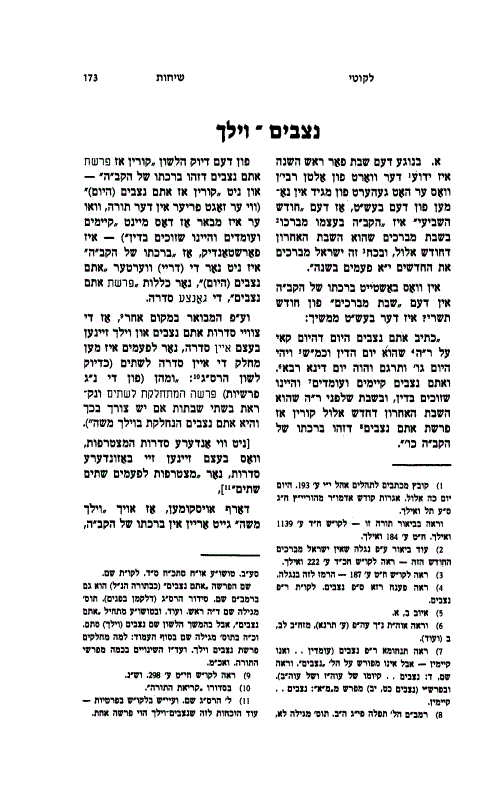
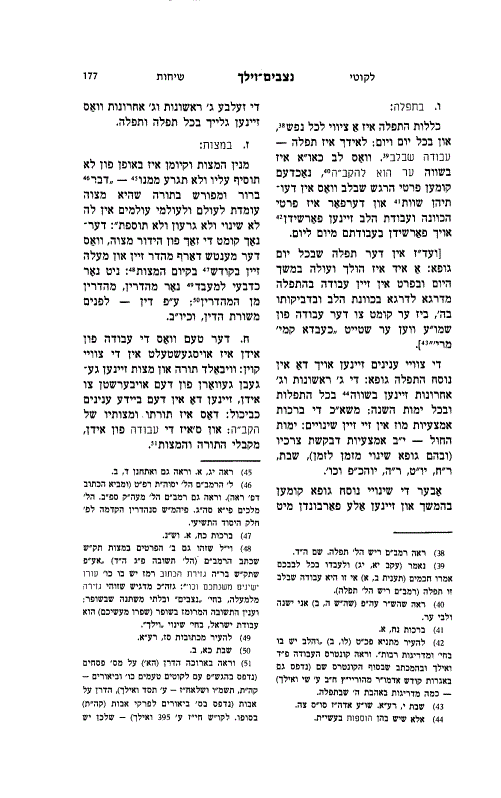
1. Regarding the Shabbos before Rosh Hashanah, there is the well-known teaching of the Alter Rebbe, which he heard from the Maggid in the name of the Baal Shem Tov,1 that the "seventh month" — "הקב"ה בעצמו מברכו" ("the Holy One, blessed be He, Himself blesses it")2 on Shabbos Mevarchim, which is the last Shabbos of the month of Elul, "and with this power the Jewish people bless the months eleven times a year."
In what does the blessing of the Holy One, blessed be He, on this "Shabbos Mevarchim" of the month of Tishrei consist? The Baal Shem Tov continues:
"It is written, "אתם נצבים היום" ("You are standing today"); 'today' refers to Rosh Hashanah,3 which is the Day of Judgment, as it is written,4 "ויהי היום" ("And it was the day…"), which the Targum renders, 'And it was the great Day of Judgment.'5 And 'you are standing' — enduring and standing,6 meaning that they are found meritorious in judgment. And on the Shabbos before Rosh Hashanah, which is the last Shabbos of the month of Elul, the portion of Atem Nitzavim is read then7 — this is the blessing of the Holy One, blessed be He, etc."
From the precise wording, "the portion of Atem Nitzavim is read then,8 which is the blessing of the Holy One, blessed be He" — and not "Atem Nitzavim (Hayom) is read then" (as he says earlier in the teaching, where he explains that this means "enduring and standing, meaning that they are found meritorious in judgment") — it is understood that "the blessing of the Holy One, blessed be He" is not only the (three) words "Atem Nitzavim (Hayom)," but the "portion of Atem Nitzavim" as a whole, the entire sidrah.
And according to what is explained elsewhere,9 that the two sidros Atem Nitzavim and Vayeilech are essentially one sidrah, only that sometimes the one sidrah is divided into two (as is precise in the wording of Rav Saadia Gaon:10 "And among them (among the fifty-three parshiyos) is a parsha that is divided into two and read on two Shabbosos if there is a need for this, and that is Atem Nitzavim, which is divided at Vayeilech Moshe"),
[unlike other sidros that are joined, which are essentially separate sidros, only that they "are sometimes joined two by two"11],
it must follow that "Vayeilech Moshe" is also included in the blessing of the Holy One, blessed be He, because it too is part of "the portion of Atem Nitzavim."
But on the other hand: from the very fact that there are years in which the sidrah is divided into two,12 and "Vayeilech Moshe" is read only after Rosh Hashanah — and certainly in those years too the blessing of the Holy One, blessed be He, on "Shabbos Mevarchim" of the month of Tishrei is not, G‑d forbid, lacking — one is compelled to say that the main blessing of the Holy One, blessed be He, is "the portion of Atem Nitzavim" itself, i.e., the part of the parsha until "Vayeilech Moshe," which in Jewish custom is specifically what is called Parshas (Atem) Nitzavim, and as it is printed in Chumashim; and the fact that "Vayeilech Moshe" is also part of the blessing of the Holy One, blessed be He, is a matter of blessing of such a kind that sometimes it can come out in actuality — openly — only after Rosh Hashanah.
2. It may be said that the explanation of this is as follows:
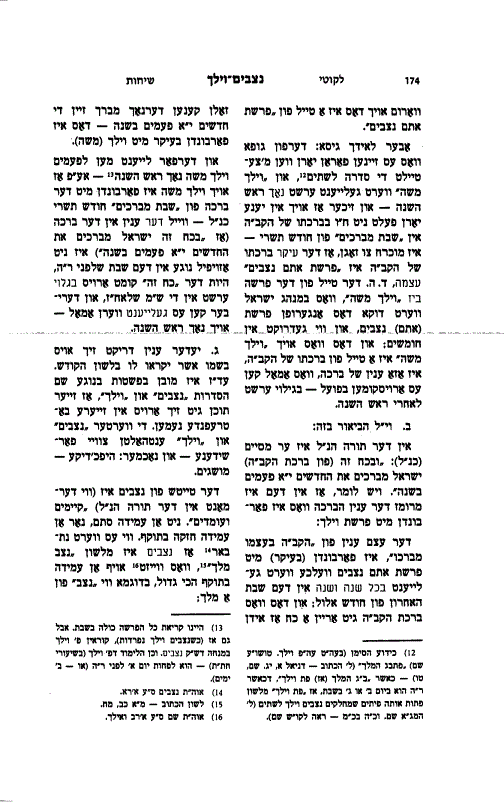
In the aforementioned teaching he concludes (as cited above): "And with this power (of the blessing of the Holy One, blessed be He) the Jewish people bless the months eleven times a year." It may be said that this alludes to the aspect of the blessing that is connected with Parshas Vayeilech:
The essential matter of "the Holy One, blessed be He, Himself blesses it" is connected (primarily) with Parshas Atem Nitzavim, which is read every single year on the last Shabbos of the month of Elul; while the fact that the blessing of the Holy One, blessed be He, imparts a power so that Jews can afterwards bless the months eleven times a year — this is connected primarily with Vayeilech (Moshe).
And that is why Vayeilech Moshe is sometimes read after Rosh Hashanah13 — even though Vayeilech Moshe is also connected with the blessing of "Shabbos Mevarchim" of the month of Tishrei, as explained above — because this aspect of the blessing (that "with this power the Jewish people bless the months eleven times a year") is not so relevant to the Shabbos before Rosh Hashanah, since "this power" comes out openly only in the Shabbos Mevarchim that follow; and therefore it can sometimes be read even after Rosh Hashanah.
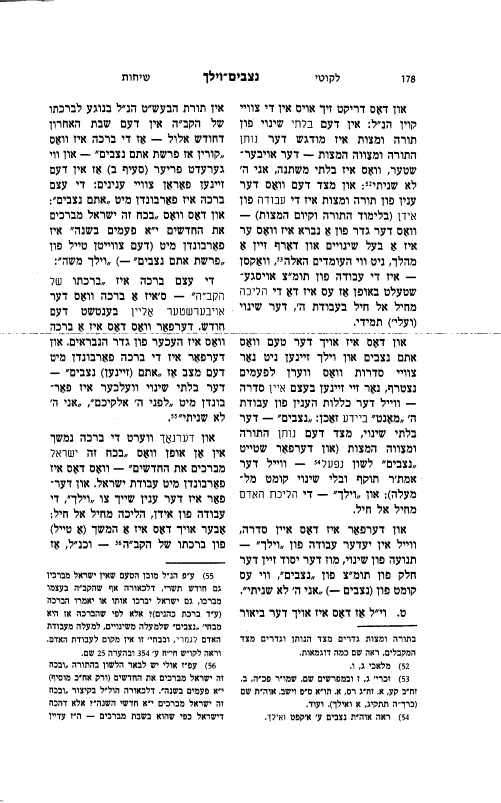
3. Every matter is expressed by its name, by which it is called in the Holy Tongue. Similarly, it is simply understood regarding the names of the sidros "Nitzavim" and "Vayeilech" that their content is expressed in their respective names. The words "Nitzavim" and "Vayeilech" contain two different — and moreover, opposite — concepts.
The meaning of Nitzavim is (as mentioned in the aforementioned teaching) "enduring and standing." Not merely standing, but a strong, firm standing. As is explained14 that Nitzavim is related to "נצב מלך" ("a deputy as king"),15 which indicates16 a standing of the greatest firmness, like the "nitzav" of a king:
Whereas the content of "Vayeilech" is going — the opposite of standing in general, and all the more so the opposite of Nitzavim — firm standing.
And nevertheless it is said that Nitzavim and Vayeilech are not merely joined together (like other sidros that are joined), but more than that: they are essentially one sidrah.
4. The key point of the explanation of this:17 The entire service of G‑d is founded on the need for both of the above lines (movements) — "Nitzavim," firm standing, without change; and "Vayeilech" — going "from strength to strength,"18 to the point of "אין להם מנוחה" ("they have no rest"),19 constant change.20
And this is so in all three pillars21 (lines) — Torah, avodah (prayer), and gemilus chassadim (mitzvos):22
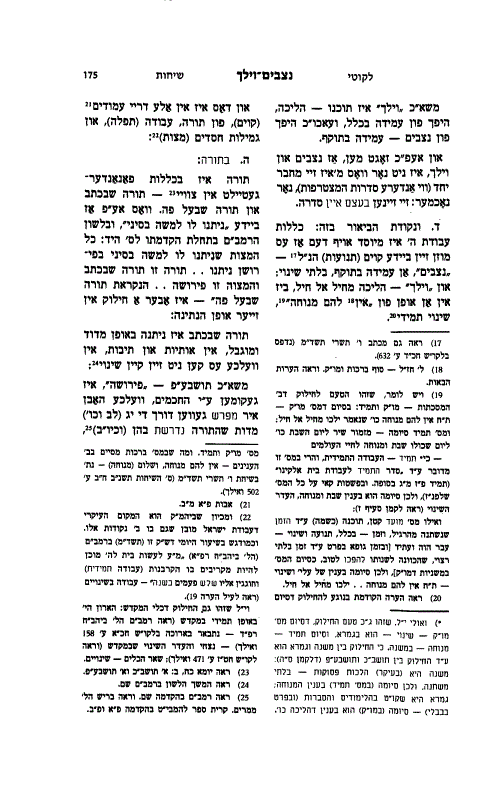
5. In Torah:
Torah in general is divided into two23 — the Written Torah and the Oral Torah. Although both "were given to Moshe at Sinai," and in the words of the Rambam at the beginning of his introduction to the Yad: "כל המצות שניתנו לו למשה בסיני בפירושן ניתנו . . תורה זו תורה שבכתב והמצוה זו פירושה . . הנקראת תורה שבעל פה" ("All the mitzvos that were given to Moshe at Sinai were given together with their explanation… 'the Torah' — this is the Written Torah; 'and the mitzvah' — this is its explanation… which is called the Oral Torah") — there is nevertheless a difference in the manner in which they were given:
The Written Torah was given in a measured and limited manner, in letters and words, in which there can be no change;24
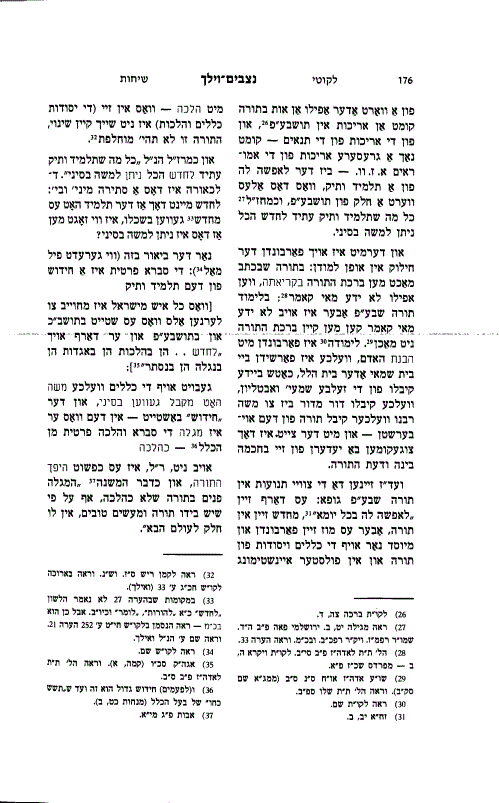
whereas the Oral Torah — "its explanation" — came through the Sages, who explained it through the thirteen (thirty-two, etc.) principles by which the Torah is expounded (and the like);25 from one word, or even one letter, in the Torah comes a lengthy elaboration in the Oral Torah,26 and from the elaboration of the Tannaim comes an even greater elaboration of the Amoraim, and so on — down to the "expanding" of a seasoned student, all of which becomes part of the Oral Torah, as our Sages say:27 "כל מה שתלמיד ותיק עתיד לחדש הכל ניתן למשה בסיני" ("Whatever a seasoned student will in the future innovate — all of it was given to Moshe at Sinai").
And connected with this is also the difference in the manner of their study: over the Written Torah one recites the blessing on the Torah when reading it, even when "he does not know what he is saying";28 but in studying the Oral Torah, if he does not know what he is saying, he cannot recite the blessing on the Torah.29 Its study30 is bound up with a person's understanding, which differs between Beis Shammai and Beis Hillel, even though both received from the same Shemaya and Avtalyon, who received generation after generation back to Moshe Rabbeinu, who received the Torah from the A-lmighty — and with time, each of them grew in wisdom, understanding and knowledge of the Torah.
And similarly, the two movements exist within the Oral Torah itself: there must be "לאפשה לה בכל יומא" ("expanding it every day"),31 innovating in Torah; but this must be connected with, and founded only upon, the rules and foundations of Torah, and in fullest harmony with halachah — in which (the foundations, rules and halachos) no change applies: "התורה זו לא תהי' מוחלפת" ("this Torah will not be exchanged").32
And as in the aforementioned saying of our Sages, "Whatever a seasoned student will in the future innovate — all [was given] to Moshe at Sinai." Seemingly this is self-contradictory: "to innovate" means that the student innovated33 it with his intellect — so how can one say that it was given to Moshe at Sinai?
But the explanation of this (as has been discussed many times34): the particular line of reasoning is an innovation of the seasoned student
[for every Jew is obligated to learn everything that is written in the Written Torah and in the Oral Torah, and he must also "לחדש . . הן בהלכות הן באגדות הן בנגלה הן בנסתר" ("innovate… whether in halachos or in aggados, whether in the revealed or in the hidden")35]:
built upon the general principles that Moshe received at Sinai; and the "innovation" consists in his revealing the particular reasoning and halachah from the general principle36 — in accordance with halachah.
If not, heaven forfend, it is simply contrary to the Torah, and as the Mishnah states:37 "המגלה פנים בתורה שלא כהלכה, אף על פי שיש בידו תורה ומעשים טובים, אין לו חלק לעולם הבא" ("One who interprets the Torah not in accordance with halachah, even though he possesses Torah and good deeds, has no share in the World to Come").
6. In prayer:
Prayer in general is a command to every soul,38 and every single day; on the other hand, prayer is "the service of the heart,"39 and the heart of every one is equally "awake" to the Holy One, blessed be He;40 after that come the particulars of the feeling in the heart, in which "their minds are not alike,"41 and therefore the particulars of intention and of the service of the heart are different,42 and they also differ in their service from day to day.
[And similarly within each day's prayer itself: a Jew goes ever higher during the day, and particularly in his service in prayer, from level to level in the intention of the heart and in his cleaving to G‑d, until he comes to the service of Shemoneh Esreh, when he stands "כעבדא קמי מריה" ("like a servant before his master").43]
These two aspects are also present in the text of the prayer itself: the first three and the last three blessings are the same44 in all the prayers and on all the days of the year; whereas in the middle blessings there must be changes: on weekdays — twelve middle blessings requesting one's needs (and within them, too, there is change from time to time), Shabbos, Yom Tov, [OCR unclear], Rosh Hashanah, Yom Kippur, etc.
But the changes in the text themselves come in sequence, and they are all connected with the same first three and last three blessings that are the same in every single prayer.
7. In mitzvos:
The number of the mitzvos and their fulfillment is in the manner of "לא תוסיף עליו ולא תגרע ממנו" ("You shall not add to it, nor subtract from it")45 — "a matter46 clear and explicit in the Torah, that it is a mitzvah that stands forever and to all eternity; it has no change, no diminution and no addition." After that comes the matter of hiddur mitzvah, that a person must beautify and "ascend in holiness"47 in the fulfillment of the mitzvos:48 not only "as it ought to be done,"49 but mehadrin, mehadrin min hamehadrin;50 from the letter of the law — to beyond the letter of the law, and the like.
8. The reason why the service of Jews is set up in these two lines: since Torah and mitzvos were given by the A-lmighty to Jews, both aspects are present in them, as it were: they are the Torah and mitzvos of the Holy One, blessed be He; and they are the service of Jews, the recipients of the Torah and the mitzvos.51
And this is expressed in the two lines mentioned above: in the changelessness of Torah and mitzvos, the Giver of the Torah and Commander of the mitzvos is emphasized — the A-lmighty, Who is unchanging, "אני ה' לא שניתי" ("I, G‑d, have not changed");52 and from the aspect that Torah and mitzvos are the service of Jews (in Torah study and the fulfillment of mitzvos) — and the definition of a created being is that he is subject to changes and must be "one who goes," not like "העומדים האלה" ("these who stand"),53 growing — the service of Torah and mitzvos is set up in such a manner that there is going from strength to strength in the service of G‑d, constant change (and ascent).
And this is also the reason why Atem Nitzavim and Vayeilech are not merely two sidros that are sometimes joined, but are essentially one sidrah — because the overall service of G‑d "demands" both things: "Nitzavim" — changelessness, from the aspect of the Giver of the Torah and Commander of the mitzvos (and that is why "Nitzavim" is in the passive form54 — because true firmness and changelessness come from Above); and "Vayeilech" — a person's going from strength to strength.
And that is why it is one sidrah: because in every service of "Vayeilech" — a movement of change — the foundation must be the element of Torah and mitzvos of "Nitzavim," as it comes from (Nitzavim —) "I, G‑d, have not changed."
9. It may be said that this is also the explanation of the aforementioned teaching of the Baal Shem Tov regarding the blessing of the Holy One, blessed be He, on the last Shabbos of the month of Elul — that the blessing is that "the portion of Atem Nitzavim is read then" — and, as discussed earlier (section 2), there are two aspects in this: the essential blessing is connected with "Atem Nitzavim"; and the fact that "with this power the Jewish people bless the months eleven times a year" is connected with (the second part of "the portion of Atem Nitzavim" —) "Vayeilech Moshe":
The essential blessing is "the blessing of the Holy One, blessed be He" — it is a blessing with which the A-lmighty Himself blesses the month. That is because it is a blessing that is above the bounds of created beings. And therefore the blessing is connected with the state in which "you are standing (nitzavim)" — the changelessness that is connected with "לפני ה' אלקיכם" ("before G‑d your G‑d"), "I, G‑d, have not changed."55
And afterwards the blessing is drawn down in such a manner that "with this power the Jewish people bless the months" — which is connected with the service of the Jewish people. And therefore this matter belongs to "Vayeilech," the service of Jews, going from strength to strength; but this too is a continuation (a part) of the blessing of the Holy One, blessed be He56 — as explained above, that "Vayeilech" is not a separate sidrah but part of "the portion of Atem Nitzavim," because the "Vayeilech" of Jews is founded upon and connected with "Atem Nitzavim," with the giving from Above.
However, since in actuality and openly, "the Jewish people bless the months" is the blessing and service of man, therefore57 it is not necessary that this always be revealed on the Shabbos before Rosh Hashanah, and consequently Parshas Vayeilech is not always read before Rosh Hashanah; sometimes it is read on the Shabbos after (but close to) Rosh Hashanah.
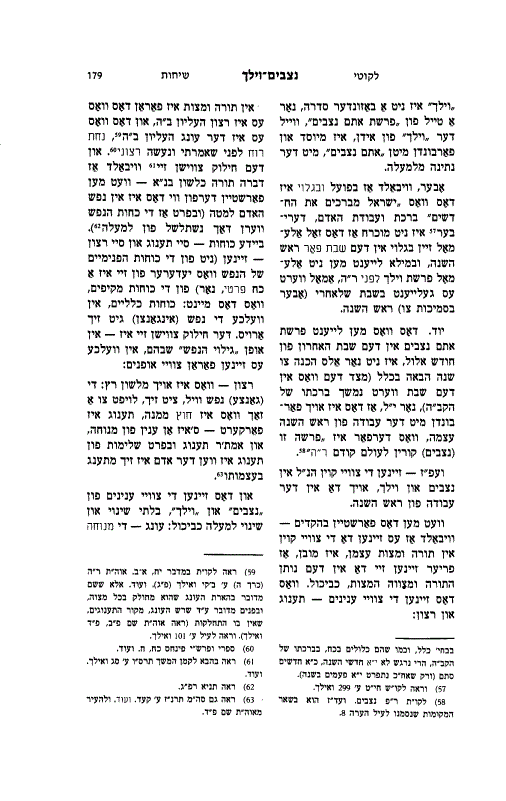
10. The reading of Parshas Atem Nitzavim on the last Shabbos of the month of Elul is not only a preparation for the coming year in general (because on this Shabbos the blessing of the Holy One, blessed be He, is drawn down); rather, it may be said that it is also connected with the service of Rosh Hashanah itself, which is why "פרשה זו (נצבים) קורין לעולם קודם ר"ה" ("this portion (Nitzavim) is always read before Rosh Hashanah").58
And accordingly, the two lines mentioned above in Nitzavim and Vayeilech are also present in the service of Rosh Hashanah.
This will be understood by way of introduction: since the two lines exist in Torah and mitzvos themselves, it is understood that they exist first in the Giver of the Torah and Commander of the mitzvos, as it were. These are the two aspects — delight and will:
In Torah and mitzvos there is the aspect that they are the Supreme Will, blessed be He, and the aspect that they are the Supreme Delight, blessed be He,59 "נחת רוח לפני שאמרתי ונעשה רצוני" ("a gratification before Me, that I spoke and My will was done").60 And the difference between them61 — since "the Torah speaks in the language of men" — will be understood from how this is in the human soul below (especially since the powers of the soul descend from Above62). Both powers — both delight and will — are (not among the inner powers of the soul, each of which is a particular power, but rather) among the encompassing powers, which means: general powers, in which the soul (as a whole) expresses itself. The difference between them lies in the manner of the "revelation of the soul" in them, of which there are two modes:
Will (ratzon) — which is also related to the word ratz ("runs"): the (entire) soul wants, is drawn, runs toward something that is outside itself. Delight is the opposite — it is a matter of rest, and true delight, and especially the perfection of delight, is when a person delights in his own essence.63
And these are the two aspects of "Nitzavim" and "Vayeilech," changelessness and change Above, as it were: delight — rest in its truest and most perfect form, in His essence — a matter of the absence of change; and will — running and inclination — a matter of movement and change.
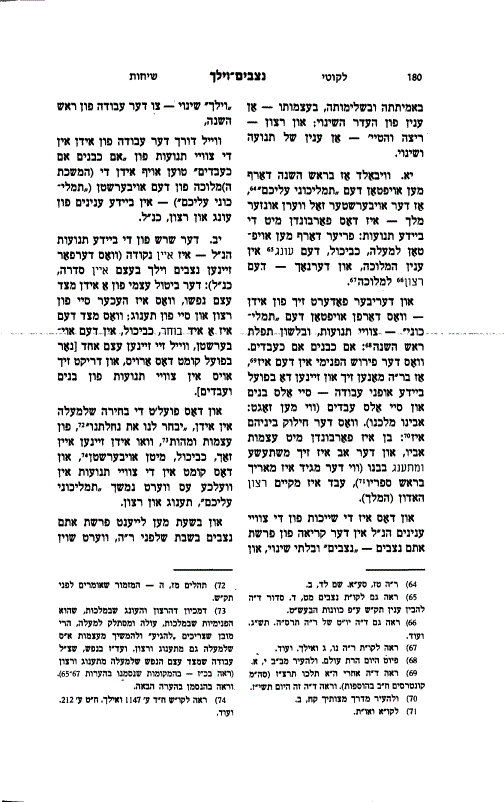
11. Since on Rosh Hashanah one must accomplish "תמליכוני עליכם" ("make Me King over you"),64 that the A-lmighty should become our King, this is connected with both movements: first one must accomplish Above, as it were, the delight65 in the matter of kingship, and afterwards — the will66 for kingship.67
And therefore two movements are required of Jews — who must accomplish the "make Me King" — and in the words of the Rosh Hashanah prayer:68 "אם כבנים אם כעבדים" ("whether as children or as servants"). The inner meaning of this is69 that on Rosh Hashanah both modes of service are demanded and are actually present — both as children and as servants (as we say: Avinu Malkeinu, "our Father, our King"). The difference between them is:70 a son is connected with his father's essence, and the father takes delight and pleasure in his son (as the Maggid elaborates at the beginning of his sefer71); a servant fulfills the will of the master (the king).
And this is the connection of the two aspects mentioned above in the reading of Parshas Atem Nitzavim — "Nitzavim," changelessness, and "Vayeilech," change — with the service of Rosh Hashanah,
because through the service of Jews in the two movements of "whether as children or as servants," Jews accomplish the (drawing down of the) Kingship of the A-lmighty ("make Me King over you") — in both aspects, delight and will, as explained above.
12. The root of both these movements is one point (which is why Nitzavim and Vayeilech are essentially one sidrah, as mentioned above): the essential self-nullification of a Jew from the aspect of the essence of his soul, which is higher than both will and delight; from this aspect a Jew chooses, as it were, the A-lmighty, because they are one essence [only that in actuality this comes out and is expressed in two movements, of children and of servants].
And this brings about the choice Above in Jews, "יבחר לנו את נחלתנו" ("He will choose our inheritance for us"),72 from the Essence and Being,73 where Jews are one thing, as it were, with the A-lmighty;74 and this comes into the two movements in which "make Me King over you" is drawn down — delight and will.
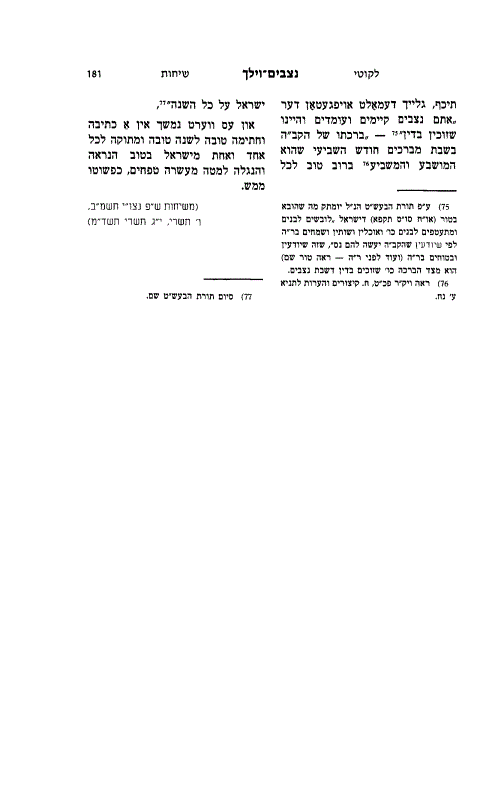
And when Parshas Atem Nitzavim is read on the Shabbos before Rosh Hashanah, there is already accomplished immediately, right then, the "you are standing — enduring and standing, meaning that they are found meritorious in judgment"75 — "the blessing of the Holy One, blessed be He, on Shabbos Mevarchim of the seventh month, which is 'המושבע והמשביע' ('satiated and satiating')76 with abundant goodness for all of Israel for the entire year,"77
and it is drawn down into a kesivah vachasimah tovah, a good inscription and sealing, for a good and sweet year for each and every Jew, with good that is visible and revealed, below ten handbreadths, in the most literal sense.
(From the sichos of Shabbos Parshas Nitzavim-Vayeilech 5742, and 6 Tishrei and 13 Tishrei 5744)
Notes
1) Kovetz Michtavim to Tehillim, Ohel Yosef Yitzchak, p. 193. Hayom Yom, 25 Elul. Igros Kodesh of the Previous Rebbe, vol. 3, end of p. 430ff. And see the explanation of this teaching in Likkutei Sichos vol. 4, p. 1139ff.; vol. 9, p. 184ff.
2) A further explanation, according to nigleh (the revealed dimension of Torah), of why the Jewish people do not bless this month — see Likkutei Sichos vol. 24, p. 222ff.
3) See Likkutei Sichos vol. 9, p. 187 — the allusion to this in nigleh.
4) See Paane'ach Raza, end of Parshas Nitzavim. Likkutei Torah, beginning of Parshas Nitzavim.
5) Iyov 2:1.
6) And see Or HaTorah, Nach, on the verse (p. 651), from Zohar II, 32b (and elsewhere).
7) See Tanchuma, beginning of Parshas Nitzavim ("standing… and we endure") — but this is not stated explicitly on the word "Nitzavim." And see there, sec. 4: "Nitzavim… the endurance of this world and of the World to Come." And in Rashi's commentary (Nitzavim 29:12) he explains [OCR unclear]: "Nitzavim… enduring."
8) Rambam, Laws of Prayer, [OCR unclear]. Tosafos, Megillah 31b, end. Tur and Shulchan Aruch, Orach Chaim 428:4. Likkutei Torah there. The name of the parsha "Atem Nitzavim" (as in the aforementioned teaching) appears also in the Rambam there; in the Siddur of Rav Saadia Gaon (cited below in the text); in Tosafos, Megillah there, s.v. "Rosh"; and elsewhere. And in the Tur and Shulchan Aruch it begins "Atem Nitzavim," but in the continuation of the wording there it is simply "Nitzavim (Vayeilech)." And so too in Tosafos, Megillah there, at the end of the page: "Why do they divide Parshas Nitzavim-Vayeilech." And similarly the variations among several commentators on the Torah. This is not the place to elaborate.
9) See Likkutei Sichos vol. 9, p. 298, and the sources cited there.
10) In his Siddur, "Krias HaTorah."
11) The wording of Rav Saadia Gaon, there. And see there in Likkutei Sichos [OCR unclear] — further proofs that Nitzavim-Vayeilech is one parsha.
12) As is known, the mnemonic (Baal HaTurim on the verse "Vayeilech"; Tur and Shulchan Aruch there) "פתבג המלך" (the wording of the verse — Daniel 1:13; there, 15): when "בג המלך" (Rosh Hashanah falls on the second or third day of the week), then "פת וילך" — "pas" in the sense of "break it into pieces" (פתות אותה פתים), i.e., that Nitzavim and Vayeilech are divided into two (the wording of the Magen Avraham there; and so in many places — see Likkutei Sichos there).
13) That is, the reading of the entire parsha on Shabbos. But even then (when Nitzavim and Vayeilech are separate), Parshas Vayeilech is read at Minchah of Shabbos Parshas Nitzavim. Likewise, the study of Parshas Vayeilech (in the Chitas portions) is at least one day (or two days) before Rosh Hashanah.
14) Or HaTorah, Nitzavim, end of p. 1201.
15) The wording of the verse — I Melachim 22:48.
16) Or HaTorah there, end of p. 1202ff.
17) See also the letter of 6 Tishrei 5744 (printed in Likkutei Sichos vol. 24, p. 632).
18) The wording of our Sages — end of Berachos and of Moed Katan. And see the following notes.
19) It may be said that this is the reason for the distinction between the two tractates Moed Katan and Tamid: at the conclusion of tractate Moed Katan — "Torah scholars have no rest, etc., as it is said, 'They go from strength to strength'"; while tractate Tamid concludes — "A psalm, a song for the Shabbos day, etc. — for the day that is entirely Shabbos and rest for eternal life." For "Tamid" is the constant service, and this tractate speaks of "the order of the Tamid for the service of the House of our G‑d" (Tamid 6:3, at its end; and simply, this refers to the entire tractate before it), and therefore its conclusion concerns Shabbos and rest, the absence of change (see below, section 7). Whereas the content of tractate Moed Katan (as its name indicates) concerns time that is changed from the usual, and time in general means movement and change — past, present and future [and within time itself, specifically undesirable time, where the intent is to change it and turn it to good, as in the conclusion of the tractate in the Mishnayos of Moed Katan]; and therefore its conclusion concerns ascent and change — "Torah scholars have no rest… they go from strength to strength."
*) And perhaps it may be said that this is also the reason for the distinction that the conclusion of tractate Moed Katan — change — is in the Gemara, while the conclusion of Tamid — rest — is in the Mishnah. For the difference between Mishnah and Gemara is similar to the difference between the Written Torah and the Oral Torah (see below, section 5): the Mishnah is (primarily) decided halachos — unchanging, and therefore its conclusion (in tractate Tamid) concerns rest; the Gemara is the give-and-take of study and reasoning (especially the Babylonian Talmud) — its conclusion (in Moed Katan) concerns going, etc.
20) See the previous note regarding the distinction between the conclusions of tractates Moed Katan and Tamid. As for tractate Berachos concluding with both aspects — "they have no rest," and peace (rest) — this is explained in the sichah of 6 Tishrei 5744 (Sefer HaSichos 5752, vol. 2, p. 502ff.).
21) Avos 1:2.
22) And since the Beis HaMikdash is the principal place of the service of the Jewish people, it is understood that these three points are present in it too. As is emphasized in the daily Rambam portion of this Shabbos (5744) (Laws of the Chosen House, beginning of ch. 1): "It is a positive mitzvah to make a House for G‑d, prepared for offering sacrifices in it (constant service), and to celebrate there three times a year" — service with changes (see above, note 19). And it may be suggested that this is also the distinction among the vessels of the Mikdash: the Ark was in the Mikdash in a constant manner (see Rambam, Laws of the Chosen House, beginning of ch. 4 — explained at length in Likkutei Sichos vol. 21, p. 158ff.) — the eternity and absence of change in the Mikdash (and see Likkutei Sichos vol. 16, p. 47ff.); the other vessels — changes.
23) See Yoma 28b: one the Written Torah and one the Oral Torah.
24) See the continuation of the wording in the Rambam there.
25) See Rambam, in the Introduction there. And see the beginning of Laws of Rebels. Kiryas Sefer by the Mabit, Introduction, chs. 1 and 2.
26) Likkutei Torah, Berachah 95d.
27) See Megillah 19b. Jerusalem Talmud, Pe'ah 2:4. Shemos Rabbah, beginning of ch. 47. Vayikra Rabbah, beginning of ch. 22. And in many places. And see note 33.
28) The Alter Rebbe's Laws of Torah Study, ch. 2, sec. 2. Likkutei Torah, Vayikra 5b — from Pardes, Gate 27, ch. 1.
29) The Alter Rebbe's Shulchan Aruch, Orach Chaim 50:2 (from the Magen Avraham there, subsec. 2). And see his Laws of Torah Study, end of ch. 2.
30) See Likkutei Torah there.
31) Zohar I, 12b.
32) See below, beginning of section [OCR unclear], and the sources cited there. And see at length Likkutei Sichos vol. 23, p. 33(ff.).
33) In the places cited in note 27 the wording is not "to innovate" but "to teach," "to say," and the like. But it does appear in many places — see the sources cited in Likkutei Sichos vol. 9, p. 252, note 21. And see there, the aforementioned page ff.
34) See Likkutei Sichos there.
35) Iggeres HaKodesh, sec. 26 (145a). And see the Alter Rebbe's Laws of Torah Study, ch. 2, sec. 2.
36) (And sometimes) this is a great innovation, to the point that the "strength" of the author of the general principle "was weakened" (Menachos 29b).
37) Avos 3:11.
38) See Rambam, beginning of Laws of Prayer. [OCR unclear].
39) It is said (Eikev 11:13): "and to serve Him with all your heart." The Sages said (Taanis 2a): What is the service of the heart? This is prayer (Rambam, beginning of Laws of Prayer).
40) See Shir HaShirim Rabbah on the verse (Song of Songs 5:2) "I am asleep, but my heart is awake."
41) Berachos 58a.
42) Note Tanya, ch. 29 (36b): "And the heart has many aspects and levels." And see Kuntres HaAvodah, ch. 4ff., and the letter at the end of that Kuntres (printed also in Igros Kodesh of the Rebbe Rashab, vol. 2, p. 310ff.) — several levels of the love of G‑d in prayer.
43) Shabbos 10a, beginning. The Alter Rebbe's Shulchan Aruch, end of sec. 95.
44) Except that there are additions in them during the Ten Days of Repentance.
45) Re'eh 13:1. And see also Vaeschanan 4:2.
46) The wording of the Rambam, Laws of the Foundations of the Torah, beginning of ch. 9 (and he cites the verse of Parshas Re'eh). And see also Rambam, Laws of [OCR unclear], end of ch. 2; Laws of Kings, [OCR unclear]; Commentary on the Mishnah, Sanhedrin, Introduction to Perek Chelek, the ninth principle.
47) Berachos 28a, and the sources cited there.
48) And it may be said that these are also the two particulars in the mitzvah of blowing the shofar, of which the Rambam writes (Laws of Repentance 3:4): "Although the blowing of the shofar on Rosh Hashanah is a Scriptural decree, there is an allusion in it, etc.: 'Awake, sleepers, from your sleep,' etc." The Scriptural decree emphasizes that it is a decree from Above — the aspect of "Nitzavim," the unchanging element in the shofar; and the matter of teshuvah alluded to in the shofar ("improve your deeds") is the service of the Jewish people — the aspect of change, "Vayeilech."
49) Note Kesubos 67a, beginning.
50) Shabbos 21b.
51) And see at length the (first) Hadran on tractate Pesachim (printed in the Haggadah with Likkutei Taamim, etc., u'Biurim — Kehot, 5747 and thereafter — p. 464ff.) and the Hadran on Avos (printed at the end of Sefer Biurim LePirkei Avos (Kehot); Likkutei Sichos vol. 17, p. 395ff.) — that therefore in Torah and mitzvos there are definitions from the aspect of the Giver and definitions from the aspect of the recipients; see there several examples.
52) Malachi 3:6.
53) Zechariah 3:7, and the commentators there. Shemos Rabbah 25:2. Zohar II, 170a. Zohar III, 260a. Torah Or, end of Parshas Vayeishev. Or HaTorah there ([OCR unclear] 823a ff.). And elsewhere.
54) See Or HaTorah, Nitzavim, p. 1189ff.
55) Based on the above, the reason is understood why the Jewish people do not also bless the month of Tishrei. For seemingly, even though the Holy One, blessed be He, Himself blesses it, the Jewish people too should bless it, or recite the blessing (similar to the Priestly Blessing)? But it is because the blessing then is from the aspect of "Nitzavim," which is above changes, entirely above man's service, and in this aspect there is no room for man's service. And see Likkutei Sichos vol. 8, p. 354, and note 25 there.
56) Accordingly, perhaps the wording in the teaching can be explained: "And with this power the Jewish people bless the months (and only afterwards does he add) eleven times a year." For seemingly it should have said briefly, "And with this power the Jewish people bless the eleven months of the year"? But the power of the Jewish people, as it is on Shabbos Mevarchim, was still in a general state, and as they are included in potential, in the blessing of the Holy One, blessed be He, what is sensed is not "the eleven months of the year" but "months" in general (and only afterwards is it particularized as "eleven times a year").
57) And see Likkutei Sichos vol. 9, p. 299ff.
58) Likkutei Torah, beginning of Parshas Nitzavim. And similarly in the other places cited above, note 8.
59) See Likkutei Torah, Bamidbar 18a–b. Or HaTorah, Rosh Hashanah (vol. 5), p. 2110ff. (ch. 3), and elsewhere. However, there it speaks of the radiance of delight that is divided in each mitzvah, whereas in the text here it speaks of the root of delight, the source of all delights, in which there is no division (see Or HaTorah there, ch. 2, and ch. 4ff.). And see above, p. 101ff.
60) Sifri and Rashi, Pinchas 28:8. And elsewhere.
61) On what follows, see Hemshech 5666, p. 63ff. And elsewhere.
62) See Tanya, beginning of ch. 3.
63) See also Sefer HaMaamarim 5657, p. 174. And elsewhere. And note Or HaTorah there, ch. 4.
64) Rosh Hashanah 16a, end; there, 34b.
65) See also Likkutei Torah, Nitzavim 49d. Siddur, the maamar beginning "Lehavin Inyan Tekias Shofar" according to the kavanos of the Baal Shem Tov.
66) See also the maamar beginning "Yom Tov shel Rosh Hashanah" 5665; 5703. And elsewhere.
67) See Likkutei Torah, Rosh Hashanah 56c ff. And elsewhere.
68) The piyut "Hayom Haras Olam." And note [OCR unclear] 10a.
69) See the maamar beginning "Acharei Hashem Elokeichem Teileichu" 5696 (Sefer HaMaamarim Kuntreisim vol. 2, in the supplements). And see the maamar beginning "Zeh Hayom" 5717.
70) And note Derech Mitzvosecha 108b.
71) Likkutei Amarim, [OCR unclear].
72) Tehillim 47:5 — the psalm recited before the blowing of the shofar.
73) For since the will and delight in Malchus, which are the inner dimension of Malchus, ascend and withdraw Above, it is understood that one must reach and draw down from the Essence of the Infinite, which is higher even than delight and will. And similarly in the soul: there must be service from the aspect of the essence of the soul, which is higher than delight and will (see on all this the sources cited in notes 65–67). And see the sources cited in the next note.
74) See Likkutei Sichos vol. 4, p. 1147ff.; vol. 9, p. 212. And elsewhere.
75) Based on the aforementioned teaching of the Baal Shem Tov, one can better appreciate what is cited in the Tur (Orach Chaim, end of sec. 581), that the Jewish people "wear white and wrap themselves in white, etc., and eat and drink and rejoice on Rosh Hashanah, because they know that the Holy One, blessed be He, will perform a miracle for them": that they know and are confident on Rosh Hashanah (and even before Rosh Hashanah — see the Tur there) is because of the blessing, etc., that they are found meritorious in judgment, given on Shabbos Nitzavim.
76) See Vayikra Rabbah 29:8. Kitzurim VeHaaros LeTanya, p. 58.
77) The conclusion of the Baal Shem Tov's teaching, there.
Key Lesson
Nitzavim and Vayeilech are one sidrah because the service of G‑d requires both firm, unchanging commitment to Torah and mitzvos as given from Above and constant growth "from strength to strength." Every advance in a Jew's service must rest on that unchanging foundation, and this pairing of delight and will, of children and servants, is what crowns G‑d as King on Rosh Hashanah and draws down a good and sweet year.