
Parshas Ha'azinu
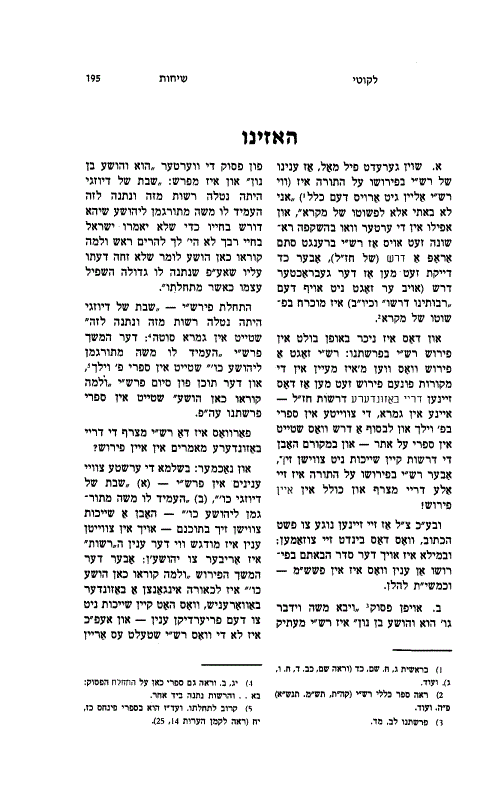
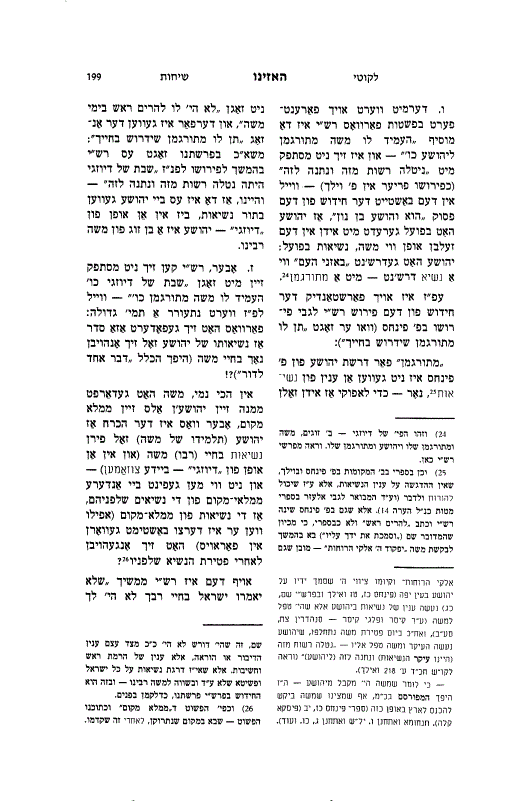
1. It has been discussed many times that the approach of Rashi in his commentary on the Torah is (as Rashi himself states the general rule) "אני לא באתי אלא לפשוטו של מקרא" ("I have come only for the plain meaning of Scripture")1; and even in the places where at first glance it appears that Rashi simply cites a derash (of the Sages), when one examines it carefully one sees that the derash he cites (if he does not say of it "our Rabbis expounded" or the like) is necessitated by the plain meaning of Scripture2.
This is strikingly evident in Rashi's commentary on our parsha: Rashi gives an explanation which, when one examines the sources of the explanation, turns out to be three separate expositions of the Sages — one in the Gemara, the second in the Sifri on Parshas Vayelech, and finally an exposition found in the Sifri on this verse itself — and in their original sources these expositions have no connection with one another; yet Rashi, in his commentary on the Torah, combines all three of them and includes them in one explanation!
Perforce we must say that they are relevant to the plain meaning of the verse, and this is what binds them together; and consequently the order in which he cites them in his commentary is also a matter of the plain meaning of Scripture — as will be explained below.
2. On the verse3 "ויבא משה וידבר גו' הוא והושע בן נון" ("Moshe came and spoke… he and Hoshea bin Nun"), Rashi copies from the verse the words "he and Hoshea bin Nun" and explains: "It was a Shabbos of diyuzgi: authority was taken from this one and given to that one. Moshe appointed a meturgeman (interpreter) for Yehoshua, so that he would expound during his lifetime, so that Israel should not say, 'During your master's lifetime you did not have [the standing] to raise your head.' And why does it call him Hoshea here? To say that his mind did not become haughty; for although greatness was given to him, he humbled himself as at his beginning."
The beginning of Rashi's commentary — "It was a Shabbos of diyuzgi: authority was taken from this one and given to that one" — is found in the Gemara, Sotah4; the continuation of Rashi's commentary, "Moshe appointed a meturgeman for Yehoshua etc.," is found in the Sifri on Parshas Vayelech5; and the content of the conclusion of Rashi's commentary, "And why does it call him Hoshea here," is found in the Sifri on our parsha, on this verse.
Why does Rashi here need to combine the three separate statements into one explanation?
Moreover: granted that the first two matters in Rashi's commentary — a) "It was a Shabbos of diyuzgi etc.," b) "Moshe appointed a meturgeman for Yehoshua etc." — are connected to each other in their content — in the second matter, too, it is emphasized how the "authority" passed to Yehoshua; but the continuation of the commentary, "And why does it call him Hoshea here etc.," is seemingly an entirely separate clarification, which has no connection to the preceding matter. And nevertheless, not only does Rashi place it in the same heading, but he even connects it with a conjunctive vav — "And why does it call him here etc."6 — as if the question arises specifically after, and in continuation of, the preceding explanation, "It was a Shabbos of diyuzgi… Moshe appointed a meturgeman etc."!
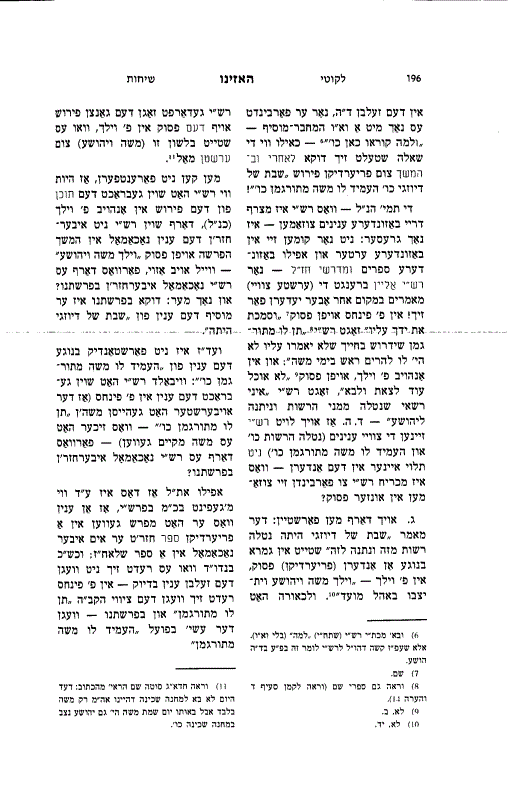
The above wonder — that Rashi combines three separate matters together — is even greater: not only do they appear in separate places, and even in separate books (of the Sages' midrashim), but Rashi himself cites the (first two) statements elsewhere, each one on its own! In Parshas Pinchas, on the verse "וסמכת את ידך עליו" ("And you shall lay your hand upon him")7, Rashi says: "Give him a meturgeman so that he may expound during your lifetime, so that they should not say of him, 'He did not have [the standing] to raise his head in the days of Moshe'"8; and at the beginning of Parshas Vayelech, on the verse "לא אוכל עוד לצאת ולבא" ("I can no longer go out and come in")9, Rashi says: "I am not permitted, for the authority has been taken from me and given to Yehoshua." That is, according to Rashi too, the two matters (the authority was taken etc., and Moshe appointed a meturgeman etc.) are not dependent on one another. What compels Rashi to connect them together in our verse?
3. We must also understand: the statement "It was a Shabbos of diyuzgi: authority was taken from this one and given to that one" appears in the Gemara with regard to another (earlier) verse, in Parshas Vayelech — "וילך משה ויהושע ויתיצבו באהל מועד" ("Moshe and Yehoshua went and stood in the Tent of Meeting")10. Seemingly, then, Rashi should have said the entire explanation on that verse in Parshas Vayelech, where this wording (Moshe and Yehoshua) appears for the first time11.
One cannot answer that since Rashi had already cited the content of this explanation at the beginning of Parshas Vayelech (as mentioned above), Rashi no longer needs to repeat the matter again later in the parsha, on the verse "Moshe and Yehoshua went" — for if so, why does Rashi need to repeat it again in our parsha? Moreover: specifically in our parsha he adds the matter of "It was a Shabbos of diyuzgi"…
Similarly, it is not understood regarding the matter of "Moshe appointed a meturgeman etc.": since Rashi already cited this matter in Parshas Pinchas (that the Al-mighty told Moshe, "Give him a meturgeman etc." — which Moshe certainly fulfilled), why does Rashi need to repeat it again in our parsha?
Even if we say that this is like what we find in many places in Rashi's commentary, that a matter he explained in an earlier book he repeats again in a later book — and all the more so in our case, where it is not speaking of exactly the same matter: in Parshas Pinchas it speaks of the command of the Holy One, blessed be He, "Give him a meturgeman," and in our parsha — of the actual deed, "Moshe appointed a meturgeman" — it is still not understood why he needs to repeat all the details, including the reason "so that Israel should not say etc.," since he already explained this in Parshas Pinchas. [For, as has been discussed many times, when Rashi repeats an explanation that he has already said earlier, he says it only briefly12; and in the places where he repeats it with all the details, it is because this is necessitated by the verses at hand.]
We must also understand: the expression "a Shabbos of diyuzgi" is translated by Rashi (on the Gemara)13: "Two pairs, two companions were in it — the beginning of the day for Moshe and its end for Yehoshua." Here Rashi evidently clarifies that "diyuzgi" cannot be translated here literally, in the sense of a "pair" (zug) — for Moshe's leadership was at the beginning of the day and Yehoshua's at its end (it was not a matter of a "pair," both together) — rather, it means "there were two companions."
This is not understood: since Rashi on the Gemara needs to clarify this (for a fifteen-year-old learning Gemara), surely he needs to do so when teaching according to the plain meaning (for a five-year-old learning Scripture)?
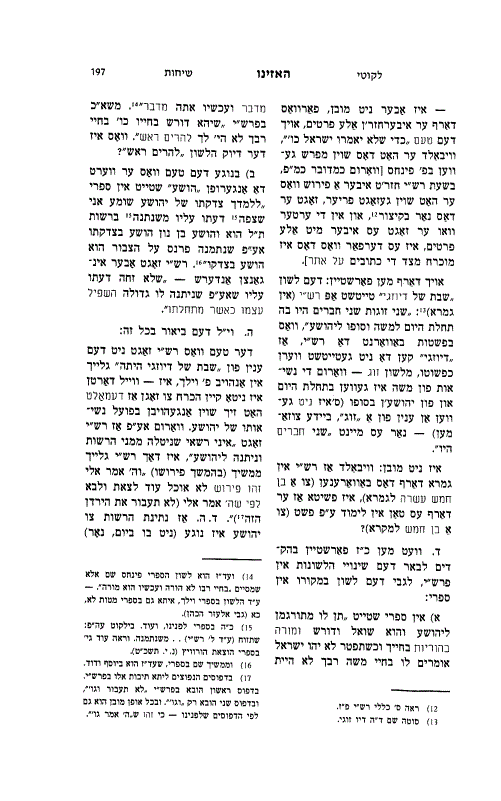
4. All this will be understood by first explaining the differences in wording in Rashi's commentary compared with the wording in its source in the Sifri:
a) In the Sifri it states: "Give Yehoshua a meturgeman, and he will ask, expound, and issue rulings during your lifetime; and when you pass away, Israel will not say to him, 'During the lifetime of Moshe your master you did not speak, and now you speak'"14. Whereas in Rashi's commentary: "so that he would expound during his lifetime etc. — during your master's lifetime you did not have [the standing] to raise your head." What is the precise significance of the expression "to raise the head"?
b) Regarding the reason he is called "Hoshea" here, the Sifri states: "To teach you the righteousness of Yehoshua. I might think that his mind became inflated15 once he was given authority — therefore the verse says, 'he and Hoshea bin Nun': Hoshea in his righteousness; although he was appointed leader over the community, he is Hoshea in his righteousness"16. Rashi, however, says something entirely different — "that his mind did not become haughty; for although greatness was given to him, he humbled himself as at his beginning."
5. The explanation of all this:
The reason Rashi does not state the matter of "It was a Shabbos of diyuzgi" right at the beginning of Parshas Vayelech is that there, there is no compelling reason to say that Yehoshua's leadership had already actually begun at that time. For although Rashi says, "I am not permitted, for the authority has been taken from me and given to Yehoshua," Rashi immediately continues (in the continuation of his commentary): "'And G‑d said to me' — this is the explanation of 'I can no longer go out and come in': because G‑d said to me ('You shall not cross this Jordan')"17. That is, the granting of authority to Yehoshua pertains (not to that very day, but) to this matter, and consequently — to the time of "crossing this Jordan." Consequently, there is no compelling reason [to say] that at the time Moshe said "I can no longer go out and come in," Yehoshua's leadership had actually already begun.
Similarly regarding the verse "Moshe and Yehoshua went and stood in the Tent of Meeting" (further on in Parshas Vayelech): in this (that Yehoshua entered the Tent of Meeting together with Moshe) there is no proof that Yehoshua was already actually a leader over Israel — this was still a fulfillment of the Al-mighty's statement, "קרא את יהושע והתיצבו באהל מועד ואצונו" ("Call Yehoshua, and stand in the Tent of Meeting, and I will command him")18.
When, however, we come to our parsha, where the verse says "and he spoke… he and Hoshea bin Nun," the question arises: what is the intent of the verse in joining Yehoshua with Moshe — how does Yehoshua (Hoshea) come in here?! Granted that Yehoshua "לא ימיש מתוך האהל" ("would not depart from within the tent")19 — he was always with Moshe — but what is the reason the Torah states it explicitly specifically here?
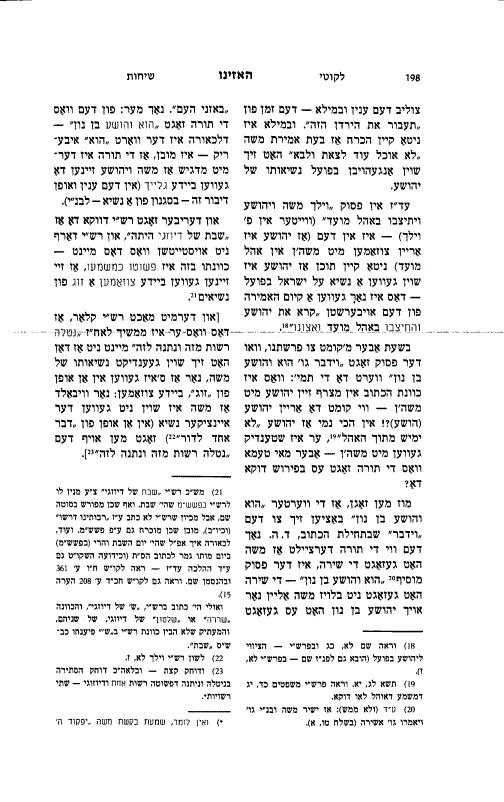
We must therefore say that the words "he and Hoshea bin Nun" refer to the word "and he spoke" at the beginning of the verse. That is, after the Torah relates that Moshe said the song, the verse adds20 "he and Hoshea bin Nun" — the song was said not only by Moshe alone, but Yehoshua bin Nun also said it "in the ears of the people." Moreover: from the fact that the Torah says "he and Hoshea bin Nun" — where seemingly the word "he" is superfluous — it is understood that the Torah thereby emphasizes that Moshe and Yehoshua were here both equal (in this matter and manner of speech — in the style of a leader — to the Children of Israel).
Therefore Rashi says specifically here that "it was a Shabbos of diyuzgi," and Rashi does not need to explain what this means: his intent here is its plain, literal meaning, that they were both together a pair of leaders21.
[And thereby Rashi makes clear that what he continues afterward, "authority was taken from this one and given to that one," does not mean that Moshe's leadership had already ended here, but that it was in the manner of a "pair," both together; only, since Moshe was no longer the sole leader (in the manner of "דבר אחד לדור" ("one leader for a generation")22), one says of this, "authority was taken from this one and given to that one"23.]
6. This also simply answers why Rashi here adds "Moshe appointed a meturgeman for Yehoshua etc." and is not satisfied with "authority was taken from this one and given to that one" (as in his explanation earlier, in Parshas Vayelech): because in this lies the novelty of the verse "he and Hoshea bin Nun" — that Yehoshua actually spoke to the Jewish people in the same manner as Moshe, actual leadership: Yehoshua expounded "in the ears of the people" as a leader expounds — with a meturgeman24.
Accordingly, we also understand the novelty of this commentary of Rashi relative to his commentary in Parshas Pinchas (where he says, "Give him a meturgeman so that he may expound during your lifetime"):
The "meturgeman" for Yehoshua's expounding in Parshas Pinchas was not a matter of [OCR unclear]25, but rather — in order to prevent the Jewish people from saying, "He did not have [the standing] to raise his head in the days of Moshe"; and therefore there was the instruction, "Give him a meturgeman so that he may expound during your lifetime." In our parsha, by contrast, Rashi says it in continuation of his preceding explanation, "It was a Shabbos of diyuzgi: authority was taken from this one and given to that one" — meaning that here it was, for Yehoshua, as leadership, to the point of being in the manner of "diyuzgi": Yehoshua is a partner (ben zug) of Moshe Rabbeinu.
7. However, Rashi cannot suffice with saying "It was a Shabbos of diyuzgi etc.; Moshe appointed a meturgeman etc.," because accordingly a great wonder arises: why was such an order necessary, that Yehoshua's leadership should begin already during Moshe's lifetime (contrary to the rule of "one leader for a generation")?!
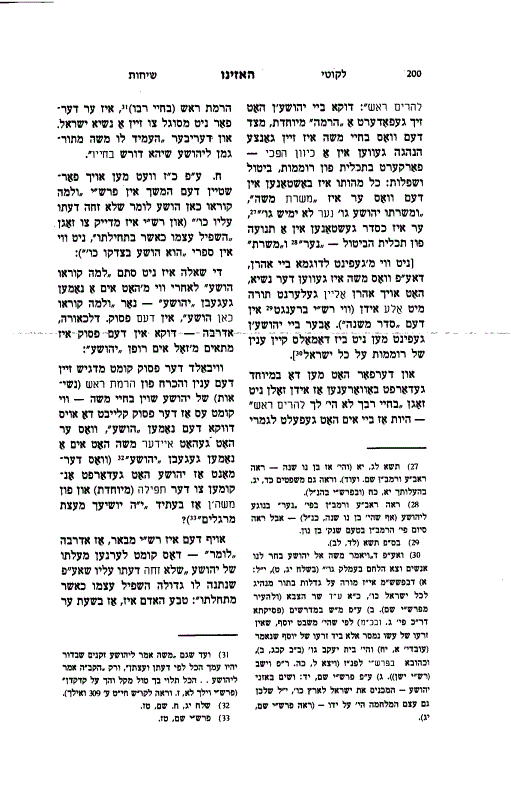
Granted that Moshe had to appoint Yehoshua as his successor; but what is the necessity that Yehoshua (Moshe's student) should exercise leadership during the lifetime of (his master) Moshe (and in the manner of "diyuzgi" — both together), and not as we find with other successors of the leaders who preceded them, that the leadership of the successor (even when he had been designated for it in advance) began after the passing of the leader before him26?
On this Rashi continues, "so that Israel should not say, 'During your master's lifetime you did not have [the standing] to raise your head'": specifically with Yehoshua a special "raising" was required, because during Moshe's lifetime his entire conduct was in the opposite direction — the very opposite of exaltedness: self-nullification and lowliness. His entire essence consisted of being "Moshe's attendant" — "ומשרתו יהושע בן נון נער לא ימיש גו'" ("and his attendant, Yehoshua bin Nun, a youth, would not depart…")27; he constantly stood in a mode of utter self-nullification — a "youth"28 and an "attendant."
[Unlike what we find, for example, with Aharon: although Moshe was the leader, Aharon too himself taught Torah to all the Jewish people (as Rashi cites29 in the "order of teaching the Mishnah"). With Yehoshua, however, we find until then no matter of exaltedness over all Israel30.]
Therefore it was specifically necessary here to ensure that the Jewish people should not say, "During your master's lifetime you did not have [the standing] to raise your head" — since he had entirely lacked any raising of the head (during his master's lifetime)31, he is therefore not fit to be a leader of Israel. And therefore "Moshe appointed a meturgeman for Yehoshua so that he would expound during his lifetime."
8. Based on all this, we will also understand the continuation in Rashi's commentary, "And why does it call him Hoshea here? To say that his mind did not become haughty etc." (and Rashi is precise in saying "he humbled himself as at his beginning," not as in the Sifri, "he is Hoshea in his righteousness etc."):
The question is not simply "why does it call him Hoshea" after he had been given the name "Yehoshua," but "And why does it call him Hoshea here," in this verse. For seemingly, on the contrary — specifically in this verse it would be fitting to call him "Yehoshua":
Since the verse comes to emphasize the matter and the necessity of Yehoshua's raising of the head (leadership) already during Moshe's lifetime — how is it that the verse here chooses specifically the name "Hoshea," which he had before Moshe gave him the name "Yehoshua"32 (which recalls that Yehoshua needed the (special) prayer from Moshe, "May G‑d save you from the counsel of the spies"33)?
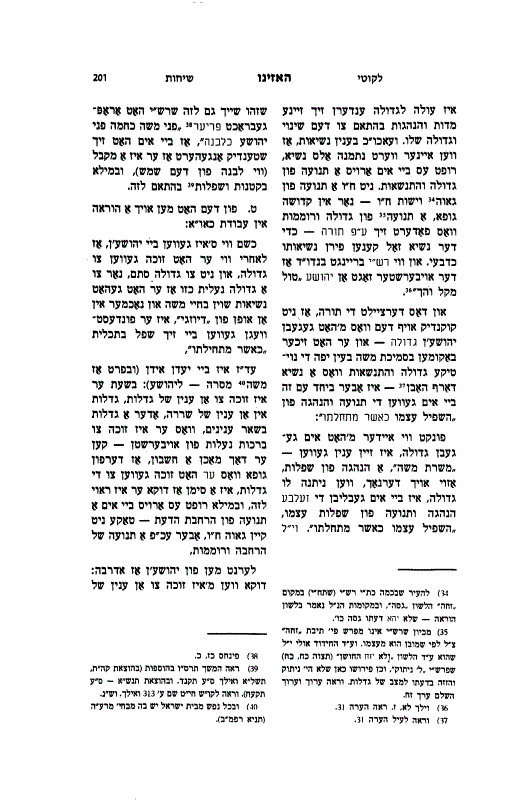
On this Rashi explains that, on the contrary, "to say" — this comes to teach Yehoshua's virtue, "that his mind did not become haughty; for although greatness was given to him, he humbled himself as at his beginning." It is human nature that when a person rises to greatness, his character traits and conduct change in accordance with his change and greatness. All the more so in the matter of leadership: when someone is appointed as a leader, it evokes in him a mode of greatness and self-elevation. Not, G‑d forbid, a mode of pride34 and self-importance, G‑d forbid — but, within holiness itself, a mode35 of greatness and exaltedness that is required according to Torah, so that the leader can conduct his leadership properly. As Rashi cites in our case, that the Al-mighty instructs Yehoshua, "Take a stick and strike"36.
And this is what the Torah relates: that notwithstanding that Yehoshua was given greatness — and he certainly received, through Moshe's generous laying of hands, the necessary greatness and self-elevation that a leader must have37 — together with this, he had the mode and conduct of "he humbled himself as at his beginning":
Just as before he was given greatness his role was "Moshe's attendant," a conduct of lowliness, so too afterward, when greatness was given to him, the same conduct and mode of self-lowliness remained with him: "he humbled himself as at his beginning." And it may be said that this is also connected to what Rashi cited earlier38, "The face of Moshe was like the sun; the face of Yehoshua like the moon" — that it was always evident in him that he was a recipient (like the moon from the sun), and consequently [he was] in smallness and lowliness39 in accordance with this.
9. From this there is also a lesson in the Divine service of each and every one:
Just as it was with Yehoshua — that after he merited greatness, and not merely ordinary greatness but such lofty greatness that he had leadership already during Moshe's lifetime, and moreover in the manner of "diyuzgi," he was nevertheless utterly lowly in his own eyes, "as at his beginning" —
so too with every Jew (especially since "Moshe40 transmitted it — to Yehoshua"): when he merits a matter of greatness — greatness in a matter of authority, or greatness in other matters, meriting lofty blessings from the Al-mighty — he could make a calculation that the very fact that he merited this greatness is a sign that it is specifically he who is worthy of it, and consequently it evokes in him a mode of expansiveness of mind — indeed not pride, G‑d forbid, but at any rate a mode of expansiveness and exaltedness.
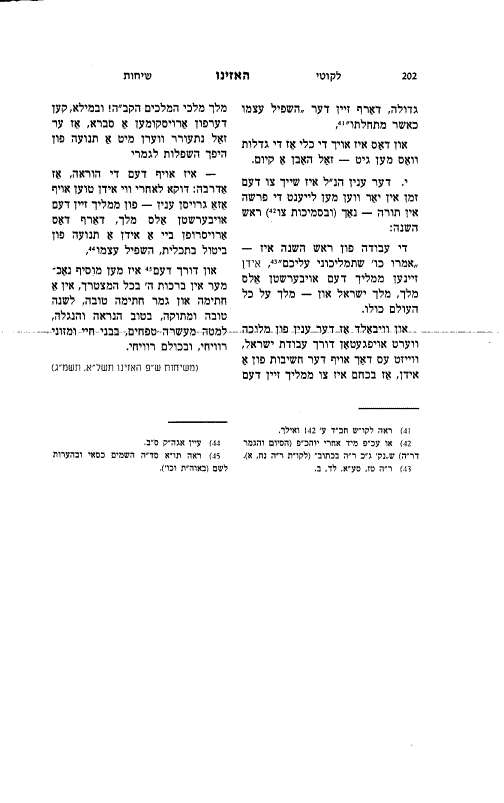
One learns from Yehoshua that, on the contrary: specifically when one merits a matter of greatness, there must be "he humbled himself as at his beginning"41;
and this is also the vessel through which the greatness that is given will endure.
10. The above matter is connected to the time of year when this parsha is read in the Torah — after (and in proximity to42) Rosh Hashanah:
The service of Rosh Hashanah is "אמרו כו' שתמליכוני עליכם" ("Say… so that you crown Me King over you")43: the Jewish people crown the Al-mighty as King — King of Israel and King over the entire world.
And since the matter of kingship is brought about through the service of the Jewish people, this shows the importance of a Jew — that it is in their power to crown the King of the kings of kings, the Holy One, blessed be He! Consequently, a line of reasoning could arise from this that he should be aroused with a mode entirely opposite to lowliness —
— on this comes the lesson that, on the contrary: specifically after Jews accomplish such a great thing — crowning the Al-mighty as King — this must evoke in a Jew a mode of utter self-nullification, "he humbled himself"44;
and through this45 one adds even more in G‑d's blessings in all that is needed, in a good sealing and final sealing, for a good and sweet year, in good that is visible and revealed, below ten handbreadths, in children, life, and abundant sustenance, and in all of them abundantly.
(From the sichos of Shabbos Parshas Ha'azinu 5721 and 5743)
Notes
1) Bereishis 3:8; ibid., 24 (and see ibid., 22; 4:8; 6:3), and elsewhere.
2) See Sefer Klalei Rashi (Kehot, 5740; [OCR unclear]), ch. 5, and elsewhere.
3) Our parsha, 32:44.
4) 13b. See also the Sifri here, on the beginning of the verse: "He came… and the authority was given into the hand of another."
5) Near its beginning. Similarly in Sifri Pinchas 27:18 (see below, notes 14 and 25).
6) In one of the Rashi manuscripts (in my possession): "Why" (without a vav). However, according to this it is difficult, for Rashi should then have said this separately, in a heading "Hoshea."
7) Ibid.
8) See also the Sifri there (and see below, section 4 and note 18).
9) 31:2.
10) 31:14.
11) See Chiddushei Aggados, Sotah ibid., who brings a proof from the verse: until that day, only Moshe alone had entered the camp of the Shechinah, i.e., the Tent of Meeting; but on the day Moshe passed away, Yehoshua too stood in the camp of the Shechinah, etc.
12) See Sefer Klalei Rashi, ch. 6.
13) Sotah ibid., s.v. "Dayo zugi."
14) Similar is the wording of the Sifri in Pinchas, ibid., except that it concludes: "During his master's lifetime he did not issue rulings, and now he issues rulings." — Similar to the wording in the Sifri on Vayelech is also found in Sifri Matos 31:21 (regarding Elazar the Kohen).
15) This is the reading in our editions of the Sifri, and elsewhere. In the Yalkut on the verse: "that [his mind] became haughty" (similar to Rashi's wording) … "once he was appointed." See further versions in the Sifri, Horowitz edition (New York, 5729).
16) The Sifri there continues that the same was true of Yosef and David.
17) In the common printings these words are absent from Rashi's commentary. In the first printing, Rashi's commentary cites "You shall not cross etc.," and in the second printing only "etc." is cited. In any case, it is understood so also according to the printings we have — for this is "that G‑d said…"
18) See ibid., 31:23, and Rashi there — the actual command to Yehoshua (cited also earlier — in Rashi on 31:7).
19) Tisa 33:11. See Rashi on Mishpatim 24:13, which implies that "the tent" is not meant literally.
20) Compare (though not exactly): "Then Moshe and the Children of Israel sang… and they said, saying: I will sing…" (Beshalach 15:1).
21) Regarding what Rashi writes, "a Shabbos of diyuzgi," it requires investigation: from where does Rashi know, according to the plain meaning of Scripture, that it was Shabbos? And although this is explicit in Sotah there — since Rashi did not write "our Rabbis expounded" (or the like) about it, this proves that it is necessitated also by the plain meaning of Scripture. Furthermore, seemingly, how could it be that it was the day of Shabbos, when (according to the plain meaning of Scripture) on the day of his passing he finished writing the Sefer Torah (and the well-known question also regarding the halachah in this matter — see Likkutei Sichos vol. 7, p. 361, and the sources cited there; see also Likkutei Sichos vol. 24, p. 208, note 15).
Perhaps Rashi's text read "Shin' of diyuzgi," meaning "rulership" or "dominion" of diyuzgi — of the two of them — and the copyist, who did not understand Rashi's intent in the abbreviation "Shin'," deciphered it as "Shabbos."
22) Rashi's wording, Vayelech 31:7.
23) This is somewhat forced — and in any case, the contradiction is forced: "taken… and given" plainly implies a single authority, whereas "diyuzgi" implies two authorities.
24) And this is the meaning of diyuzgi — two pairs: Moshe and his meturgeman, and Yehoshua and his meturgeman. See the commentators on Rashi here.
25) So too in the Sifri, in both places, in Parshas Pinchas and in Vayelech, the emphasis is not on the matter of leadership, but on his being able to issue rulings and to speak (and similarly what is explained regarding Elazar in Sifri Matos, as above, note 14). However, in Parshas Pinchas too Rashi changed [the wording] and wrote "to raise the head," and not as in the Sifri, because since what is spoken of there ("And you shall lay your hand upon him") comes in continuation of Moshe's request, "Let the L‑rd, G‑d of the spirits… appoint," it is understood that also [OCR unclear].
*) One cannot say that, because of Moshe's request, "Let the L‑rd, G‑d of the spirits… appoint," and its fulfillment — the command of G‑d, that he laid his hands upon Yehoshua generously (Pinchas 27:16ff., and Rashi there, 23) — a matter of leadership came about in Yehoshua, only that it was subordinate to Moshe (similar to "an emperor and a viceroy" — Sanhedrin 98b, end), and afterward, on the day of Moshe's passing, they exchanged, so that Yehoshua became the primary one and Moshe subordinate to him — "authority was taken from this one (i.e., the primary leadership) and given to that one (to Yehoshua)" (see Likkutei Sichos vol. 24, p. 218ff.) — for to say that Moshe received from Yehoshua is contrary to what is well known in many places, even though we find that Moshe requested to enter the Land in such a manner (Sifri Pinchas 27:12 (piska 135); Tanchuma Va'eschanan 6; Yalkut Shimoni Va'eschanan 3:26; and elsewhere).
26) As is the simple meaning of "memaleh makom" (successor; literally, one who fills the place) and its simple content — one who comes into a place that has been vacated, after the one who preceded him.
27) Tisa 33:11 (and he was then 56 years old — see Ibn Ezra and Ramban there, and elsewhere). See also Mishpatim 24:13; Beha'aloscha 11:28 (and Rashi on the aforementioned verses).
28) See Ibn Ezra and Ramban on the meaning of "youth" regarding Yehoshua (even though he was 56 years old, as above) — but see the conclusion of the Ramban's commentary, on the reason he is called "bin Nun."
29) In the order of teaching the Mishnah, Tisa (34:32).
30) And although "Moshe said to Yehoshua, 'Choose men for us, and go out and fight Amalek…'" (Beshalach 17:9), it may be said: a) According to the plain meaning of Scripture, this does not indicate greatness as a leader of all Israel etc., but only like a commander of the army (and note Rashi there). b) According to what is stated in the Midrashim (Pesikta deRav Kahana, piska 3, and elsewhere): because he was from the tribe of Yosef, for the descendants of Esav are delivered only into the hand of the descendants of Yosef, as it is said (Ovadiah 1:18), "And the house of Yaakov shall be…" (Bava Basra 123b), as cited in Rashi earlier (Vayeitzei 30:25; [OCR unclear]). c) According to Rashi there, 14 — "And place it in the ears of Yehoshua: he who will bring Israel into the Land etc." — it may be said that therefore the war itself was also conducted by him (see Rashi there, 13).
31) To the extent that even Moshe told Yehoshua, "The elders of the generation shall be with you; everything according to their opinion and their counsel," and only the Holy One, blessed be He, told Yehoshua, "… everything depends on you; take a stick and strike them on their heads" (Rashi, Vayelech 31:7; see Likkutei Sichos vol. 19, p. 309ff.).
32) Shelach 13:8; ibid., 16.
33) Rashi ibid., 16.
34) Note that in several Rashi manuscripts (in my possession), instead of "became haughty" (zachah) the wording is "became coarse" (gasah); and in the aforementioned places it is stated in the language of instruction — "that his mind should not be coarse etc."
35) Since Rashi does not explain the meaning of the word "zachah," we must say that its meaning is self-evident. And by way of a fine point, perhaps it may be said that it is like the expression "and the breastplate shall not be loosened (yizach)" (Tetzaveh 28:28), which Rashi explains as "an expression of detachment"; and so its meaning here is that he became detached and shifted in his mind to a state of greatness. See the Aruch and Aruch HaShalem, entry zach.
36) Vayelech 31:7. See note 31.
37) See above, note 31.
38) Pinchas 27:20.
39) See Hemshech 5666, in the additions (Kehot edition, 5731 and on), end of p. 554 (and in the 5751 edition — end of p. 578). See also Likkutei Sichos vol. 9, p. 313ff., and the sources cited there.
40) And every soul of the House of Israel contains something of the level of Moshe Rabbeinu (Tanya, beginning of ch. 42).
41) See Likkutei Sichos vol. 24, p. 142ff.
42) Or at least immediately after Yom Kippur (the conclusion and completion of it [i.e., of Rosh Hashanah]), which is also [OCR unclear] (Likkutei Torah, [OCR unclear]).
43) Rosh Hashanah 16a, end; 34b.
44) See Iggeres HaKodesh, epistle 2.
45) See Torah Or, beginning of the maamar "HaShamayim Kis'i," and the notes there (in Or HaTorah etc.).
Key Lesson
Even after Yehoshua was granted leadership alongside Moshe, he "humbled himself as at his beginning." So too, when a Jew merits greatness or blessing — and even after crowning G‑d as King on Rosh Hashanah — this should evoke deeper self-nullification, which is the vessel that allows the greatness and G‑d's blessings to endure and increase.