
Parshas Re'eh
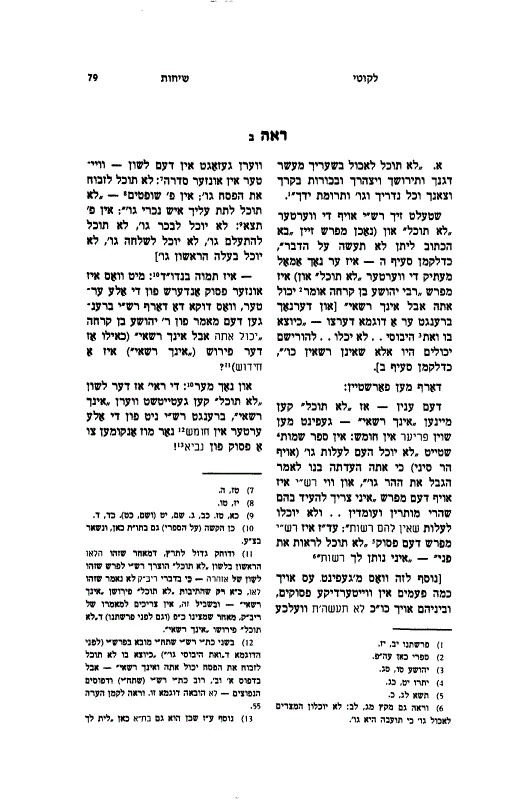
1. "לא תוכל לאכול בשעריך מעשר דגנך ותירשך ויצהרך ובכורות בקרך וצאנך וכל נדריך וגו׳ ותרומת ידך" ("You cannot eat within your gates the tithe of your grain, your wine and your oil, nor the firstborn of your cattle and your flock, nor any of your vows, etc., nor the offering of your hand")1.
Rashi pauses on the words "לא תוכל" ("you cannot") and (after explaining, "בא הכתוב ליתן לא תעשה על הדבר" ("Scripture comes to place a negative commandment upon the matter"), as will be discussed below in section 5, he again quotes the words "you cannot" and) explains: "רבי יהושע בן קרחה אומר2 יכול אתה אבל אינך רשאי" ("Rabbi Yehoshua ben Korchah says: You are able, but you are not permitted"). [And afterward he brings an example of this — "כיוצא בו ואת היבוסי . . לא יכלו . . להורישם3 יכולים היו אלא שאינן רשאין כו׳" ("Similar to it: 'And the Yevusites . . . could not . . . drive them out' — they were able, but they were not permitted, etc."), as will be discussed below in section 2.]
This needs to be understood:
This idea — that "you cannot" can mean "you are not permitted" — is already found earlier in Chumash. In the book of Shemos4 it says, "לא יוכל העם לעלות גו׳ כי אתה העדתה בנו לאמר הגבל את ההר גו׳" ("The people cannot ascend, etc." (onto Mount Sinai) "for You warned us, saying, 'Set boundaries around the mountain,' etc."), and Rashi explains on this: "איני צריך להעיד בהם שהרי מוזהרין ועומדין . . ולא יכולו לעלות שאין להם רשות" ("I do not need to warn them, for they are already warned . . . and they cannot ascend, for they do not have permission"). Similarly, Rashi explains the verse5 "לא תוכל לראות את פני" ("You cannot see My face") — "איני נותן לך רשות" ("I do not give you permission")6.
[This is in addition to the fact that one also finds it several times in the verses that follow, among them also a good number of negative commandments that are stated in this expression — further on in our sidrah7: "לא תוכל לזבוח את הפסח גו׳" ("You cannot slaughter the Pesach offering, etc."); in Parshas Shoftim8: "לא תוכל לתת עליך איש נכרי גו׳" ("You cannot set over yourself a foreigner, etc."); in Parshas Ki Seitzei9: "לא יוכל לבכר גו׳" ("He cannot grant the birthright, etc."), "לא תוכל להתעלם גו׳" ("You cannot hide yourself, etc."), "לא יוכל לשלחה גו׳" ("He cannot send her away, etc."), "לא יוכל בעלה הראשון גו׳" ("Her first husband cannot, etc.").]
— It is therefore puzzling in our case10: In what way is our verse different from all these places, that specifically here Rashi must bring the statement of Rabbi Yehoshua ben Korchah, "You are able, but you are not permitted" (as though this interpretation, "you are not permitted," were a novelty)11?
And even more: the proof that the expression "you cannot" can be rendered "you are not permitted" Rashi does not bring from all these places in Chumash12, but must resort to a verse from the Prophets13!
The puzzle is even greater: on almost the same matter as in our parsha, Rashi explains on the words "לא אוכל עוד לצאת ולבוא" ("I can no longer go out and come in") in Parshas Vayelech14: "יכול שנתשש כחו כו׳ מהו לא אוכל איני רשאי שנטלה ממני הרשות וניתנה ליהושע" ("One might think that his strength had weakened, etc. What, then, is 'I cannot'? I am not permitted, for the authority has been taken from me and given to Yehoshua"). Rashi could thus have brought here an example from that verse in Chumash (where Rashi himself deduces and proves the content of "You are able, but you are not permitted") — and not an example specifically from the Prophets!
It must also be understood:
a) Rashi's way is to state the explanation of the word (or verse) directly, without stating the "question" (or "difficulty") it contains. So in our case, too, he should have said (briefly): "'You cannot' — you are not permitted."
Although this is the wording of Rabbi Yehoshua ben Korchah — it is not the purpose of Rashi's commentary on the Torah to quote the statements of the Sages in their exact wording, as has been discussed several times15.
b) The well-known point of precision: why does Rashi bring the statement in the name of the one who said it (Rabbi Yehoshua ben Korchah16), unlike the vast majority of Rashi's explanations, where he does not mention the name of the author of the statement?
And as has been discussed several times17, Rashi does this only in a case where the name of the author of the statement adds further understanding to his explanation.
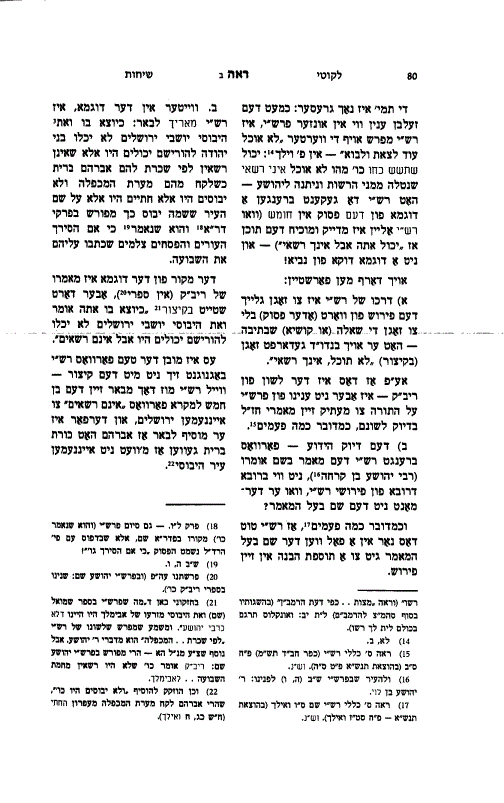
2. Further, in the example, Rashi elaborates: "כיוצא בו ואת היבוסי יושבי ירושלים לא יכלו בני יהודה להורישם יכולים היו אלא שאינן רשאין לפי שכרת להם אברהם ברית כשלקח מהם מערת המכפלה ולא יבוסים היו אלא חתיים היו אלא על שם העיר ששמה יבוס כך מפורש בפרקי דר״א18 והוא שנאמר19 כי אם הסירך העורים והפסחים צלמים שכתבו עליהם את השבועה" ("Similar to it: 'And the Yevusites, the inhabitants of Jerusalem, the children of Yehudah could not drive them out' — they were able, but they were not permitted, because Avraham had made a covenant with them when he took the Cave of Machpelah from them. And they were not Yevusites but Chittites, only [they were called so] after the city, whose name was Yevus. So it is explained in Pirkei DeRabbi Eliezer. And this is what is said: 'Unless you remove the blind and the lame' — images on which they had written the oath").
The source of the example is the statement of Rabbi Yehoshua ben Korchah (in the Sifri20), but there it is stated briefly21: "כיוצא בו אתה אומר ואת היבוסי יושבי ירושלים לא יכלו להורישם יכולים היו אבל אינם רשאים" ("Similar to it you say: 'And the Yevusites, the inhabitants of Jerusalem, they could not drive them out' — they were able, but they were not permitted").
The reason Rashi is not satisfied with this brief version is understandable: Rashi must explain to the five-year-old beginning Scripture why "they were not permitted" to capture Jerusalem, and therefore he adds the explanation that Avraham had made a covenant that the city of the Yevusites would not be captured22.
One must, however, understand:
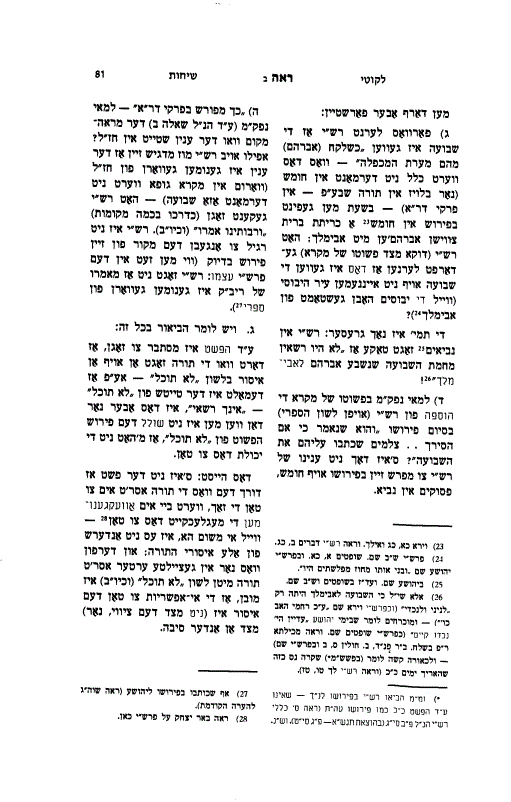
c) Why does Rashi learn that the oath was made "when he (Avraham) took the Cave of Machpelah from them" — which is not mentioned at all in Chumash (but only in the Oral Torah, in Pirkei DeRabbi Eliezer) — when we find explicitly in Chumash23 a covenant made between Avraham and Avimelech? Rashi should (precisely according to the plain meaning of Scripture) have learned that this was the oath not to capture the city of the Yevusites (since the Yevusites descended from Avimelech24).
The puzzle is even greater: Rashi on the Prophets25 indeed says that "לא היו רשאין מחמת השבועה שנשבע אברהם לאבימלך" ("they were not permitted because of the oath that Avraham swore to Avimelech")26!
d) What difference does it make, in the plain meaning of Scripture, that Rashi adds (to the wording of the Sifri) at the conclusion of his explanation, "And this is what is said: 'Unless you remove . . .' — images on which they had written the oath"? It is not Rashi's purpose, in his commentary on Chumash, to explain verses in the Prophets.
e) "So it is explained in Pirkei DeRabbi Eliezer" — what difference does it make (similar to question b above) where the matter is found in the words of the Sages? Even if Rashi must emphasize that the matter was taken from the Sages (since such an oath is not mentioned in Scripture itself), Rashi could have said (as is his way in several places) "ורבותינו אמרו" ("And our Sages said"), or the like. Rashi is not accustomed to give the exact source of his explanation (as we see in this very comment of Rashi: Rashi does not say that the statement of Rabbi Yehoshua ben Korchah was taken from the Sifri27).
3. The explanation of all this may be said to be as follows:
According to the plain meaning, it is reasonable to say that where the Torah states a prohibition with the expression "you cannot" — although the meaning of "you cannot" is then "you are not permitted," this is only when the simple meaning of "you cannot," that one does not have the ability to do it, is not negated.
That is to say: the meaning is not that through the Torah forbidding him to do the thing, the possibility of doing it is taken away from him28 — for if it were because of this, it would be no different from all the prohibitions of the Torah. And from the fact that only in a limited number of places does the Torah forbid with the expression "you cannot" (or the like), it is understood that the impossibility of doing the forbidden act is (not because of the command, but) because of another reason.
And this can be in several ways, for example29:
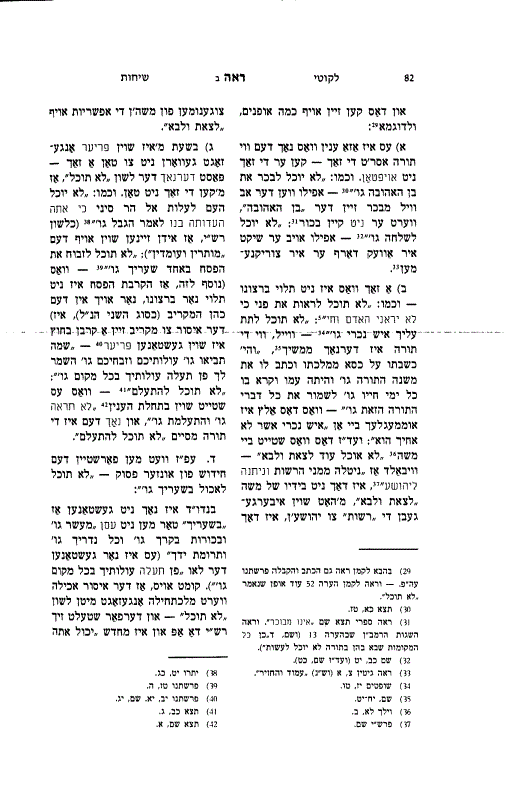
a) It is a matter such that after the Torah has forbidden it, he cannot accomplish the thing. For example: "לא יוכל לבכר את בן האהובה גו׳" ("He cannot grant the birthright to the son of the beloved, etc.")30 — even when the father wants to make the "son of the beloved" the firstborn, he does not become a firstborn31; "He cannot send her away, etc."32 — even if he sends her away, he must take her back33.
b) A matter that does not depend on his will. For example: "לא תוכל לראות את פני כי לא יראני האדם וחי" ("You cannot see My face, for man shall not see Me and live"); "You cannot set over yourself a foreigner, etc."34 — because, as the Torah continues afterward35, "והי׳ כשבתו על כסא ממלכתו וכתב לו את משנה התורה גו׳ והיתה עמו וקרא בו כל ימי חייו גו׳ לשמור את כל דברי התורה הזאת גו׳" ("And it shall be, when he sits upon the throne of his kingdom, that he shall write for himself a copy of this Torah, etc., and it shall be with him, and he shall read in it all the days of his life, etc., to keep all the words of this Torah, etc.") — all of which is impossible for "איש נכרי אשר לא אחיך הוא" ("a foreigner who is not your brother"). And similarly, what is said of Moshe36, "I can no longer go out and come in" — since "the authority has been taken from me and given to Yehoshua"37, it is no longer in Moshe's hands "to go out and come in"; the "authority" has already been handed over to Yehoshua, so the possibility "to go out and come in" has been taken away from Moshe.
c) When one has already been warned earlier not to do something, the expression "you cannot" then fits afterward, meaning that one cannot do the thing. For example: "The people cannot ascend Mount Sinai, for You warned us, saying, 'Set boundaries,' etc."38 (in Rashi's words, the Jewish people were already "מוזהרין ועומדין" ("warned") about this); "לא תוכל לזבוח את הפסח באחד שעריך גו׳" ("You cannot slaughter the Pesach offering within one of your gates, etc.")39 — where (in addition to the fact that offering the Pesach does not depend only on his will, but also on the Kohen who offers it (like the second category above),) the prohibition of offering a sacrifice outside had already been stated earlier40: "שמה תביאו גו׳ עלותיכם וזבחיכם גו׳ השמר לך פן תעלה עלותיך בכל מקום גו׳" ("There you shall bring, etc., your burnt offerings and your sacrifices, etc. . . . Beware lest you offer up your burnt offerings in any place, etc."); "You cannot hide yourself"41 — for it is already stated at the beginning of the passage42, "לא תראה גו׳ והתעלמת גו׳" ("You shall not see, etc., and hide yourself, etc."), and after that the Torah concludes, "You cannot hide yourself."
4. Based on this, one will understand the novelty of our verse, "You cannot eat within your gates, etc.":
In our case, it had not yet been stated that "within your gates" one may not eat "the tithe, etc., and the firstborn of your cattle, etc., and all your vows, etc., and the offering of your hand" (what had already been stated was the prohibition "lest you offer up your burnt offerings in any place, etc."). It follows that the prohibition of eating is stated from the outset with the expression "you cannot" — and therefore Rashi pauses here and introduces the novel idea, "You are able, but you are not permitted": that even in such a case the expression "you cannot" fits (since the Torah's prohibition itself negates the possibility of doing the thing).
This, however, is not a sufficient explanation, because:
a) According to this, the proof is not similar to the case at hand. In the example of "And the Yevusites . . . they could not drive them out — they were able, but they were not permitted," the prohibition was not stated with the expression "they could not" of that verse; rather, it comes because of the earlier oath!
b) Although an explicit prohibition against eating the tithe, etc., outside is not found earlier in the Torah, one already knows of the prohibition from an earlier command stated in positive form43: "והבאתם שמה . . ואכלתם שם גו׳" ("And there you shall bring . . . and there you shall eat, etc."). So "you cannot" here is seemingly no different from the other places in the Torah where "you cannot" is stated in connection with a prohibition that had already been stated earlier.
c) Since "you cannot" is ultimately suitable for every prohibition, why does the Torah use the expression "you cannot" specifically for this prohibition44?
5. One will understand this by first explaining Rashi's first comment on this verse: "'You cannot' — Scripture comes to place a negative commandment upon the matter."
The wording "to place a negative commandment, etc." Rashi uses in three more places in our parsha, near our verse: a) "השמר לך פן תעלה עולותיך בכל מקום אשר תראה" ("Beware lest you offer up your burnt offerings in any place that you see") — to place a negative commandment upon the matter45. b) "השמר לך פן תעזוב את הלוי גו׳" ("Beware lest you forsake the Levi, etc.") — to place a negative commandment upon the matter46. c) "את כל הדבר אשר אנכי מצוה גו׳ תשמרו לעשות" ("Every matter that I command, etc., you shall be careful to do") — to place a negative commandment upon the positive commandments stated in the parsha47.
But specifically in our verse Rashi lengthens his wording: "Scripture comes to place a negative commandment upon the matter"48.
The explanation of this may be said to be, simply: in the other three places, the verse is not out merely to add a negative commandment — there are further novelties in those verses: a) "Beware, etc., lest you offer up your burnt offerings in any place that you see" — "אשר יעלה בלבך, אבל אתה מקריב ע״פ נביא כו׳" ("[any place] that comes to your mind; but you may offer by the word of a prophet, etc.") (Rashi). b) "Beware lest you forsake the Levi all your days upon your land" — "אבל בגולה אינך מוזהר עליו יותר מעניי ישראל" ("but in exile you are not warned about him more than about the poor of Israel") (Rashi). c) "Every matter, etc., you shall be careful to do; לא תוסף עליו ולא תגרע ממנו" ("you shall not add to it and you shall not subtract from it").
Whereas in our verse, "You cannot eat within your gates, etc.," "Scripture comes to place a negative commandment upon the matter" — the verse comes for nothing more than to add a negative commandment49.
But this itself requires explanation: What difference does the emphasis make, that the entire intent of the verse is "to place a negative commandment"?
It is therefore reasonable to say that here one must have the negative commandment (not as in other places, merely to add to the severity of the matter, in punishment and the like) — in our case there is a special emphasis on the explicit prohibition, and therefore there is a special verse for it.
6. The explanation of this may be said to be:
Here the subject is the tithe and sacred offerings, etc., whose eating is a mitzvah. One could therefore have thought (when learning according to the plain meaning) that the command to (bring and) eat them in Yerushalayim is an additional mitzvah on top of the mitzvah of eating the tithe and sacred offerings, etc., in general. That is to say, one would have said that these are two mitzvos that are not dependent on one another: (a) eating the tithe and sacred offerings, etc.; (b) eating them in Yerushalayim, "במקום אשר יבחר ה׳" ("in the place that the L‑rd will choose")50.
And therefore, when someone is prevented by circumstances beyond his control and cannot eat his tithe or sacred offerings, etc., in Yerushalayim, it might have occurred to one to say51 that he (may — and on the contrary,) must eat them in his own place, "within your gates," in order to fulfill at least the mitzvah of eating the tithe and sacred offerings, etc. —
— About this, "Scripture comes to place a negative commandment upon the matter": eating in Yerushalayim is not an additional mitzvah, but an indispensable condition; one may not eat them in another place...
And this is the sequence in Rashi's commentary: after he explains that the (general) intent of the verse is "(Scripture comes) to place a negative commandment upon the matter," he explains the words "you cannot" — "You are able, but you are not permitted." For once one knows that "Scripture comes to place a negative commandment upon the matter," it becomes understandable why the Torah states the prohibition with the expression "you cannot."
The explanation of this:
By "you are able," Rashi means (not only the physical ability to eat outside Yerushalayim — what would that teach us?! — but) the "mitzvah-ability"52 to eat "within your gates" because of (the above reasoning about the) mitzvah of eating the tithe and sacred offerings, etc. (as above). And in this the verse introduces a novelty — "You cannot . . . you are not permitted": the warning negates the mitzvah-ability. That is, with this prohibition the verse teaches that outside Yerushalayim there is no mitzvah of eating the tithe and sacred offerings, etc.
And based on this one will also understand why Rashi brings the example specifically from the Prophets ("And the Yevusites, etc.") — because specifically there it corresponds to the novelty in our verse:
To conquer "the Yevusites, the inhabitants of Jerusalem" there is seemingly a command — "והורשתם את כל יושבי הארץ גו׳ וישבתם בה גו׳ והנחלתם את הארץ גו׳" ("And you shall drive out all the inhabitants of the land, etc., and you shall dwell in it, etc., and you shall take possession of the land, etc.")53. Consequently, "they were able" not only because of the physical might of the Jewish people54, but because of G‑d's command — and about this Scripture informs us that because of the oath "they could not drive them out," "for they were not permitted." That is, "they could not — they were not permitted" is because of the oath: the command to conquer the land did not apply from the outset with regard to the Yevusites. [This is similar to our case, where "You cannot eat within your gates" reveals that "within your gates" there is no mitzvah55 of eating the tithe, etc.]
7. Seemingly, however, this is entirely incomprehensible: how can one say that because of the oath to the children of Ches, G‑d's command to conquer the entire Land of Israel should not apply? On the contrary, G‑d's command (after the Giving of the Torah) should nullify56 the obligation that arose from the earlier oath!
The explanation of this is:
Although according to the law the oath had no force (because of G‑d's command to conquer the Land of Israel)57, nevertheless, since in the view of the Yevusites the oath did have force, had the Jewish people disregarded the oath, a desecration of G‑d's Name would have resulted. And therefore "they could not . . . drive them out . . . for they were not permitted" — because on account of the desecration of G‑d's Name, the Jewish people conducted themselves as though the oath had force.
[This is similar to what we find with the Givonites, regarding whom "ויכרות להם ברית לחיותם וישבעו למו" ("He made a covenant with them to let them live, and they swore to them")58, and therefore "לא נוכל לנגוע בהם" ("we cannot touch them")59: although "לא תחיה שבועה עילוויהו כלל" ("the oath did not take effect upon them at all")60 (because the Givonites had deceived the Jewish people), nevertheless "לא קטלינהו משום קדושת השם" ("they did not kill them because of the sanctity of G‑d's Name")60.]
And based on this one can explain why Rashi explains that the oath was (not Avraham's oath to Avimelech, but) the covenant "when he took the Cave of Machpelah from them" — because this further magnifies the desecration of G‑d's Name involved (had the Jewish people not conducted themselves according to the oath):
According to the covenant with the children of Ches, not conquering Jerusalem was a condition of the acquisition of the Cave of Machpelah. It follows that had the oath not been kept, Avraham's acquisition of the Cave of Machpelah would (in the view of the Yevusites) have been retroactively annulled, and consequently the Patriarchs and Matriarchs would have been buried in a grave not theirs61!
And to prevent the desecration of G‑d's Name (that the Yevusites would say that the Jewish people do not care that the Patriarchs and Matriarchs are buried in a grave not theirs), "they could not . . . drive them out."
8. Rashi, however, cannot be satisfied with this alone — for the "five-year-old beginning Scripture" will ask: since, because of the desecration of G‑d's Name, the Jewish people were not permitted to capture the city of the Yevusites, how then was it ultimately taken from them62?
Therefore Rashi must conclude, "And this is what is said: 'Unless you remove the blind and the lame' — images on which they had written the oath." King David took away the images on which the oath had been written, and in this way the memory of the oath was nullified. (And as is simply understood, after some 800 years had already passed since the covenant with the children of Ches, one could easily nullify the memory of the oath by removing the images on which they had written the oath63.)
[And this is the precise meaning of "Unless you remove the blind and the lame — images on which they had written the oath": here it was not necessary to remove the oath itself — the oath was void in any case, its force had been removed; one needed only to remove the images64 on which the oath had been inscribed, in order to nullify the desecration of G‑d's Name involved65.]
Ultimately, however, it is still not smooth: since there were living Yevusites who did know of the oath (and who said to David, "לא תבוא הנה כי אם הסירך גו׳" ("You shall not come here unless you remove, etc.")), with regard to them, what did the removal of the blind and the lame accomplish?
Therefore Rashi refers to Pirkei DeRabbi Eliezer — "So it is explained in Pirkei DeRabbi Eliezer." In Pirkei DeRabbi Eliezer, after it relates the oath of Avraham, etc., it states, "ואח״כ קנה (דוד) את עיר היבוסי לישראל66 בכתב עולם לאחוזת עולם . . . שש מאות שקלים כו׳" ("And afterward he (David) acquired the city of the Yevusites for Israel, with an everlasting deed, as an everlasting possession . . . six hundred shekels, etc."). And since David acquired the city of the Yevusites for the full price67, this entirely nullified any claim whatsoever of the Yevusites to the city of Jerusalem68.
9. On the basis of all the above, one can explain why Rashi brings the statement in the name of the one who said it — Rabbi Yehoshua ben Korchah:
A "sharp" student can ask: since a Jew has the mitzvah of eating the tithe and sacred offerings, etc., how will he explain to himself that because he is prevented by circumstances beyond his control and cannot go to Yerushalayim, he therefore "cannot eat" even within his gates?
Rashi says that this statement was said by Rabbi Yehoshua ben Korchah. Among the well-known statements of Rabbi Yehoshua ben Korchah is the statement69: "למה קדמה פרשת שמע לוהי׳ אם שמוע כדי שיקבל עליו עול מלכות שמים תחלה ואחר כך מקבל עליו עול מצות" ("Why does the section of Shema precede [the section of] VeHayah Im Shamoa? So that one should first accept upon himself the yoke of the Kingdom of Heaven, and afterward accept upon himself the yoke of the mitzvos").
And this is the explanation in our matter: before a Jew has acceptance of the yoke of the mitzvos, he must first have acceptance of "the yoke of the Kingdom of Heaven," the yoke of the King of kings, the Holy One, blessed be He, Who commanded, "לא תוכל לאכול בשעריך גו׳ כי אם לפני ה׳ אלקיך תאכלנו במקום אשר יבחר ה׳ אלקיך בו" ("You cannot eat within your gates, etc.; rather, before the L‑rd your G‑d shall you eat it, in the place that the L‑rd your G‑d will choose").
(From the sichos of Shabbos Parshas Re'eh, 5727)
Notes
1) Our parsha, 12:17.
2) Sifri here, on the verse.
3) Yehoshua 15:63.
4) Yisro 19:23.
5) Ki Sisa 33:20.
6) See also Mikeitz 43:32: "The Egyptians could not eat, etc., for it is an abomination, etc."
7) 16:5.
8) 17:15.
9) 21:16; 22:3; there, verse 19 (and there, verse 29); 24:4.
10) The Torah Temimah here also raised this question (on the Sifri), and left it requiring further study.
11) It is a very forced answer to say that since this is the first prohibition stated with the expression "you cannot," Rashi needed to explain that it is an expression of warning. For Rabbi Yehoshua ben Korchah's words do not say that it is a prohibition, but only that the words "you cannot" mean "you are not permitted" — and for this, Rabbi Yehoshua ben Korchah's statement is not needed, since we have found several times (also before our parsha) that "you cannot" means "you are not permitted."
12) In two manuscripts of Rashi that have been published, Rashi's commentary includes (before the example of "And the Yevusites, etc."): "Similar to it: 'You cannot slaughter the Pesach offering' — you are able, but you are not permitted." But in the first and second printings, most of the (published) manuscripts of Rashi, and the common printings, this example is not brought. See also below, note 55.
13) In addition to the fact that Targum Onkelos here also renders it "לית לך רשות" ("you have no permission") [OCR unclear] Rashi (and see "Mitzvos . . . according to the opinion of the Ramban" (in his glosses at the end of the Ramban's Sefer HaMitzvos), negative commandment 12: "And Onkelos translated in all of them, 'You have no permission'").
14) 31:2.
15) See Kelalei Rashi (Kfar Chabad, 5740), ch. 8, sec. 2 (in the 5751 edition, ch. 9, sec. 5), and the sources cited there.
16) Note that in Rashi on II Shmuel (5:6), our text reads: "Rabbi Yehoshua ben Levi."
17) See Kelalei Rashi, there, sec. 6ff. (in the 5751 edition, ch. 5, sec. 16ff.), and the sources cited there.
18) Ch. 36. — The conclusion of Rashi's comment ("And this is what is said, etc.") also has its source in Pirkei DeRabbi Eliezer there, except that in the printing with the commentary of the Radal, the verse "Unless you remove, etc." was omitted!
19) II Shmuel 5:6.
20) Our parsha, on the verse (and in Rashi on Yehoshua there: "We learned in the Sifri: Rabbi Yehoshua ben Korchah, etc.").
21) In the Chizkuni here, s.v. "What Rashi explained in the book of Shmuel (there), 'And the Yevusites were of the seed of Avimelech' — that is not in accordance with Rabbi Yehoshua." This implies that he understands Rashi's wording, "because he made . . . the Machpelah," to be from the words of Rabbi Yehoshua. But besides the fact that it requires investigation where he derives this from — it is explicit in Rashi on Yehoshua there: "Rabbi Yehoshua ben Korchah says, etc., that they were not permitted because of the oath . . . to Avimelech."
22) So too he needed to add, "And they were not Yevusites, etc.," for Avraham took the Cave of Machpelah from Efron the Chittite (Chayei Sarah 23:8ff.).
23) Vayera 21:23ff. And see Rashi on Devarim 2:23.
24) Rashi on [OCR unclear] there; Shoftim 1:21. And in Rashi on Yehoshua there: "And the people of that district were of the Philistines."
25) On Yehoshua there. And similarly on Shoftim and II Shmuel there.
26) Except that one can say that the oath to Avimelech was only "to my son and my grandson" (and as Rashi on Vayera there: "thus far extends a father's compassion, etc.") — and one is compelled to say that in the days of Yehoshua "his grandson was still alive" (as Rashi on Shoftim there; and see Mechilta, beginning of Beshalach; Bereishis Rabbah 54:2; Chullin 60b and Rashi there). And seemingly it is difficult to say (according to the plain meaning of Scripture) that such a miracle occurred, that he lived so long (and see Rashi on Lech Lecha 15:16).
*) Nevertheless, Rashi brought it in his commentary on Nach — which is not as closely bound to the plain meaning as his commentary on the Torah (see Kelalei Rashi, mentioned above, ch. 2, sec. 3 [in the 5751 edition, ch. 3, sec. 9], and the sources cited there).
27) Although he writes it in his commentary on Yehoshua (see the marginal gloss to the previous note).
28) See Be'er Yitzchak on Rashi here.
29) On what follows, see also HaKsav VeHaKabbalah, our parsha, on the verse. — And see below, note 52, for another way in which "you cannot" is said.
30) Ki Seitzei 21:16.
31) See Sifri, Ki Seitzei there: "He is not made the firstborn." And see the glosses of the Ramban cited in note 13 (and there, [OCR unclear]: "all the places where 'he cannot do' comes in the Torah").
32) There, 22:19 (and similarly there, verse 29).
33) See Gittin 90a (and the sources cited there): "he must arise and take her back."
34) Shoftim 17:15.
35) There, verses 18–19.
36) Vayelech 31:2.
37) Rashi there.
38) Yisro 19:23.
39) Our parsha, 16:5.
40) Our parsha, 12:11; there, verse 13.
41) Ki Seitzei 22:3.
42) Ki Seitzei there, verse 1.
43) Our parsha, 12:6–7. And although this verse speaks of Shiloh (Rashi there, verse 11; and see Rashi there, verse 5), and the positive commandment regarding Yerushalayim is stated only later (verse 18), "But before the L‑rd your G‑d shall you eat it, etc." — yet: a) In Rashi's commentary (there, verse 6), what is written there, "your tithes," includes "to eat within the wall"** (which simply refers to Yerushalayim). b) Further, and mainly: from the plain wording of Rashi here, "to place a negative commandment upon the matter," it is proven that the matter* had already been stated before it (as written in the Re'em and the Gur Aryeh here). And simply, one can say that it is understood by inference from the lesser to the greater from the command "and there you shall eat" regarding Shiloh.
*) Note that according to halacha no positive mitzvah at all is counted to eat the second tithe in Yerushalayim (only a prohibition against eating it outside the wall). And in the Minchas Chinuch (mitzvah 442): "that there should be a positive mitzvah incumbent to eat it in Yerushalayim . . . we have not heard from any of the Rishonim" (but see Ritva, Makkos 19b). This is not the place [to elaborate].
**) Note that Rashi's wording, as in the Ramban there, is "לפנים מן המחיצה" ("within the partition").
44) See, regarding the halacha, Sifri D'vei Rav on the Sifri, our parsha here.
45) 12:13.
46) There, verse 19.
47) 13:1.
48) See also the Re'em and Maskil LeDavid here.
49) In Rashi on Ki Savo (26:14), from the verse "You cannot eat within your gates" a warning is derived against "eating in impurity." But in addition to what the Re'em writes here, that "the main point and plain sense of this prohibition is only a warning against eating it outside the wall" — from the fact that Rashi brings it only later, in Parshas Ki Savo, and did not explain it in its place, it is proven that the plain meaning of the verses in our parsha compels only that "Scripture comes to place a negative commandment, etc.," and not that there is a new law here (see Kelalei Rashi, ch. 4, [OCR unclear] (in the 5751 edition, [OCR unclear])), and elsewhere.
50) As in the verse that follows here — 12:18 (and see also there, verse 11).
51) See also Gur Aryeh here.
52) See Tzafnas Paneach on the Torah here (and elsewhere): "[OCR unclear] 'you cannot' is said, meaning that even causing this is forbidden . . . there is still no prohibition" (and see there the cases in which one is not liable regarding the tithe). And note the [OCR unclear] here, that the expression "you cannot" comes "mostly in a place where in another circumstance one could do so . . . in contrast to what is written, that at the time the bamos were permitted they could eat shelamim offerings anywhere; now . . . you cannot, etc."* — and see Rashi on Ki Savo (there): "'You cannot' . . . with disqualified consecrated offerings, 'within your gates you shall eat it' . . . but this you cannot eat in the manner of eating 'within your gates' stated elsewhere."
*) And as to why Rashi did not explain it this way — one can say that this is because the permission of the bamos relates (mainly) to offering the shelamim and not to eating them. If so, it should have said "you cannot" regarding the prohibition of offering up "in any place" (above, verse 13). More can be said; this is not the place [to elaborate].
53) Masei 33:52ff. (and elsewhere).
54) See Pirkei DeRabbi Eliezer there: "Were not Israel as the sand of the sea?"
55) And perhaps one can explain the version in Rashi (see above, note 12) that brings an example from "You cannot slaughter the Pesach offering" — based on what was explained elsewhere (Likkutei Sichos vol. 28, p. 72ff.), that the Pesach in Egypt did not have the status of a sacrifice, but only of a "slaughtering" that each person slaughtered specifically in his own house, etc. Therefore it occurred to them that one could bring the Pesach in a state of impurity (Behaaloscha 9:6ff.) — for they thought that the fact that the Pesach of later generations is offered upon the altar is only an additional element in the Pesach (see there at length, and note 46 there). And similarly in our case: the verse needed to warn, "You cannot slaughter the Pesach offering within one of your gates, etc.," in order to negate the "mitzvah-ability" to slaughter the Pesach within one of your gates (like the Pesach in Egypt), and it teaches us thereby that "within one of your gates" there is from the outset no mitzvah to slaughter the Pesach.
*) Note also the Chizkuni on the verse (16:5), "You cannot slaughter the Pesach offering."
56) And see Radal on [OCR unclear] there, sec. 96.
57) And with the prohibition "You shall not let [any soul] live," the oath was nullified immediately upon their entry, even before the seven [years] in which they conquered.
58) Yehoshua 9:15.
59) There, verse 19.
60) Gittin 46a. Rambam, Laws of Kings, ch. 6, halacha 5.
61) See also the commentary Toldos Adam on the Sifri here. And although Avraham said, "I will take it by law" (Rashi on Chayei Sarah 23:4), and as Toldos Adam asked there (and there, that the purchase was only "to put the matter at ease"; and see also Likkutei Sichos vol. 10, p. 62ff.) — yet according to the plain meaning, through G‑d's assurance to Avraham the land was not yet actually acquired by him (as explained in Likkutei Sichos vol. 16, p. 146 (and see there, p. 204, and in the notes there); and see there, p. 150ff., an explanation of Rashi's wording, "I will take it by law"*).
*) Based on what is explained below in note 66, that the acquisition of the Cave of Machpelah was only of private ownership (and not of the general ownership, the sovereignty of the children of Ches), one can say that Avraham's intention was: if they would sell him the private ownership and the Cave of Machpelah, good; and if not, then by this it would become revealed that the time had now come for the fulfillment of the assurance, "לזרעך אתן את הארץ הזאת" ("To your seed I will give this land"), and he would take from him the general ownership as well. This is not the place [to elaborate]. And see Likkutei Sichos vol. 30, end of p. 83ff.
62) And perhaps one can say that this relates also to his children's ownership of the Land of Israel — for the first inheritance of the Jewish people in the Land of Israel was [OCR unclear], "so that the nations of the world cannot . . . say that they are stolen in their hands," which was accomplished specifically through Avraham's purchase (Bereishis Rabbah 79:7). And see Likkutei Sichos vol. 25, p. 91.
63) This is not so according to the explanation that it was said because of the oath to Avimelech — for "in the days of David the generations mentioned in the oath had already passed" (Rashi on II Shmuel 5:8; and see Radak there, verse 6 (and similarly on Yehoshua 15:63); Chizkuni on our parsha here; and elsewhere. — And in Rashi on Sotah 10a, beginning: "because they had violated the oath first"). — And see above, note 26.
64) And perhaps Rashi alludes with this word that this also involved the nullification of idolatry (like the command in our parsha (12:3) and elsewhere, "ופסילי אלקיהם תגדעון" ("and the carved images of their gods you shall cut down")) — see also Radal on Pirkei DeRabbi Eliezer there (and according to the version of the Aruch (entry "Ivver") and the Radak (II Shmuel there), so it is explicit in Pirkei DeRabbi Eliezer there: "hated by David's soul" — he hates hearing about and serving idolatry). And based on this, it is all the more understandable why Rashi did not bring here what he wrote in his commentary on II Shmuel there, that "the blind and the lame" were named after Yitzchak and Yaakov, etc. — for here the emphasis is that they were idolatrous images.
65) See also [OCR unclear] and the commentary of the Maharzu on Rashi here; Radal there; and elsewhere.
66) This word, it can seemingly be said, emphasizes another point — the kingdom of Israel, not a private holding of an individual Jew (David)* that is located within the kingdom of the Yevusites. This is unlike the acquisition of the Cave of Machpelah, where we do not find that Avraham conquered the kingdom of the children of Ches (and this makes a practical difference regarding taxes, "the law of the kingdom is law," the law of the king who breaches a fence, etc., in the land of his kingdom, and so on). And based on this, what is written in the text (and in the notes) requires investigation. This is not the place [to elaborate]. And see at length on all this Likkutei Sichos vol. 30, p. 82ff.
*) As is explicit in the continuation of the wording there: "he took from every tribe, etc."
67) I Divrei HaYamim 21:22–24.
68) See Likkutei Sichos vol. 10, p. 62ff. And see further, regarding the halacha, Likkutei Sichos vol. 16, p. 105, marginal gloss to note 45, and the sources cited there.
69) Mishnah, Berachos, beginning of ch. 2. — Regarding a matter so well known: accepting the yoke of the Kingdom of Heaven, etc., the mitzvah of reciting the Shema, etc.
Key Lesson
Rashi teaches that "you cannot eat within your gates" negates not physical ability but the "mitzvah-ability": outside the place G‑d chose, eating the tithe and sacred offerings is no mitzvah at all, for the place is an indispensable condition. This reflects Rabbi Yehoshua ben Korchah's principle that acceptance of the yoke of Heaven precedes acceptance of the yoke of the mitzvos — a Jew fulfills a mitzvah as the King commanded it, not as his own reasoning would suggest.