
Parshas Korach
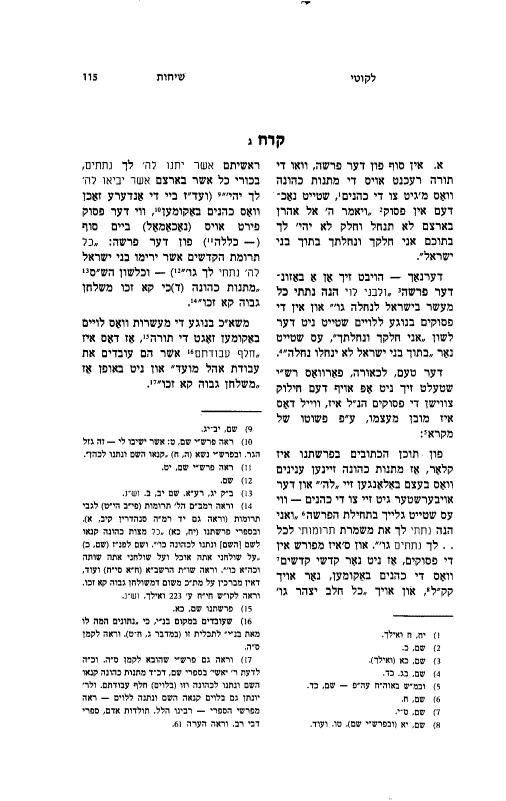
1. At the end of the parsha, where the Torah enumerates the priestly gifts1 that are given to the kohanim, it then states in the verse: "ויאמר ה׳ אל אהרן בארצם לא תנחל וחלק לא יהי׳ לך בתוכם אני חלקך ונחלתך בתוך בני ישראל" ("And G‑d said to Aharon: In their land you shall not inherit, and you shall have no portion among them; I am your portion and your inheritance among the Children of Israel")2.
After that, a separate passage begins: "ולבני לוי הנה נתתי כל מעשר בישראל לנחלה גו׳" ("And to the children of Levi, behold, I have given every tithe in Israel as an inheritance, etc.")3; and in the verses concerning the Levites the expression "I am your portion and your inheritance" does not appear. It says only: "בתוך בני ישראל לא ינחלו נחלה" ("Among the Children of Israel they shall not inherit an inheritance")4.
The reason, seemingly, why Rashi does not pause over the difference between the above verses is that this is self-evident5 according to the plain meaning of Scripture:
From the content of the verses in our parsha it is clear that the priestly gifts are matters that in essence belong "to G‑d," and G‑d gives them to the kohanim — as stated right at the beginning of the passage: "ואני הנה נתתי לך את משמרת תרומותי לכל . . לך נתתים גו׳" ("And I, behold, I have given you the charge of My terumos, of all . . . to you I have given them, etc.")6. And it is explicit in the verses that not only the kodshei kodashim (most holy offerings) that the kohanim receive7, but also kodashim kalim (offerings of lesser holiness)8, and also "כל חלב יצהר גו׳ ראשיתם אשר יתנו לה׳ לך נתתים, בכורי כל אשר בארצם אשר יביאו לה׳ לך יהיו" ("all the best of the oil, etc., their first portion which they give to G‑d, to you I have given them; the first fruits of all that is in their land, which they bring to G‑d, shall be yours")9 (and similarly with the other things that kohanim receive10, as the verse concludes (once again) at the end (— the general statement11) of the passage: "כל תרומת הקדשים אשר ירימו בני ישראל לה׳ נתתי לך גו׳" ("All the terumos of the holy things which the Children of Israel set apart for G‑d, I have given to you, etc.")12) — and in the words of the Talmud13: "מתנות כהונה (ד)כי קא זכו משלחן גבוה קא זכו" ("When they acquire the priestly gifts, they acquire them from the table of the Most High")14.
In contrast, regarding the tithes that the Levites receive, the Torah says15 that this is "חלף עבודתם אשר הם עובדים את עבודת אהל מועד" ("in exchange for their service16 which they perform, the service of the Tent of Meeting"), and not in a manner of "from the table of the Most High they acquire"17.
And as for what the verse18 says, "כי את מעשר בני ישראל אשר ירימו לה׳ תרומה נתתי ללוים לנחלה" ("For the tithe of the Children of Israel which they set apart for G‑d as a terumah, I have given to the Levites as an inheritance") — one may say that it is understood from Rashi's commentary — "הכתוב קראו תרומה עד שיפריש ממנו תרומת מעשר" ("Scripture calls it terumah until he separates from it terumas maaser") — that the Torah's calling it "which they set apart for G‑d as a terumah" is not on account of the tithe itself, but because of the portion of terumas maaser that is (still) found within the tithe, which must be given to the kohen.
Accordingly, it is also understood that the wording of the verse19, "And to the children of Levi, behold, I have given every tithe in Israel as an inheritance in exchange for their service, etc.," does not mean to say that the giving itself comes (from the fact that Jews give to G‑d, and consequently it is afterwards) "from the table of the Most High (they acquire)"; rather, "I have given . . . as an inheritance" to the Levites — the giving to the Levites is from the outset in the manner of an "inheritance," as is also stated in the later verses20: "I have given to the Levites as an inheritance," "כי תקחו מאת בני ישראל את המעשר אשר נתתי לכם מאתם בנחלתכם" ("When you take from the Children of Israel the tithe which I have given you from them as your inheritance").
Therefore we see that regarding the kohanim it says "I am your portion and your inheritance" — they receive G‑d's portion and inheritance — whereas regarding the Levites it does not say "I am your portion and your inheritance": what they receive is not as "חלק ה׳" ("G‑d's portion")22, but as a share that is set apart for them, "in exchange for their service" (as above). And as is also stated later in the verse: "ואכלתם אותו בכל מקום וביתכם כי שכר הוא לכם חלף עבודתכם באהל מועד" ("You may eat it in every place, [you] and your household, for it is a reward for you in exchange for your service in the Tent of Meeting")21.
2. We must, however, understand the continuation and conclusion of the verse concerning the kohanim: "I am your portion and your inheritance among the Children of Israel" [and on the other hand, concerning the Levites the verse states (twice) the opposite emphasis: "Among the Children of Israel they shall not inherit an inheritance"].
The Ohr HaChaim23 explains that by "I am your portion and your inheritance, etc." the intent of the verse is to say — that which is "מיוחד לי" ("set aside for Me"); "I am your inheritance" is "among the Children of Israel" — "שאין לך דבר בעם ישראל שאין להקב״ה חלק עמהם ונוטלו הכהן בתבואות הארץ בפירות האילן בלחם בבשר ביין בשמן ושאר הכ״ד מתנות" ("for there is nothing among the people of Israel in which the Holy One, blessed be He, does not have a share with them, and the kohen takes it — in the produce of the land, in the fruit of the tree, in bread, in meat, in wine, in oil, and the rest of the twenty-four gifts").
This, however, requires further explanation: what relevance does the emphasis have here, that the priestly gifts are "among the Children of Israel"? On the contrary, the main content of the priestly gifts in our parsha is that they are things which G‑d gives23* to the kohanim; and this is indeed the reason for the juxtaposition of the passage of the priestly gifts to the dispute of Korach — to inform us that G‑d gave "כ״ד מתנות כהונה בברית מלח עולם" ("twenty-four priestly gifts with an everlasting covenant of salt")24. What relevance, then, does the addition have here, that this is "among the Children [of Israel]"?
3. We must also understand: In Parshas Eikev, where it speaks about the entire tribe of Levi — "בעת ההיא הבדיל ה׳ את שבט הלוי גו׳" ("At that time G‑d set apart the tribe of Levi, etc.")25 — the verse26 states: "על כן לא הי׳ ללוי חלק ונחלה עם אחיו ה׳ הוא נחלתו" ("Therefore Levi had no portion or inheritance with his brothers; G‑d is his inheritance"), so that for the Levites, too, "G‑d is his inheritance" — and as Rashi explains: "נוטל פרס מזומן מבית המלך" ("he takes a ready allowance from the king's house"). And so too it says in Parshas Shoftim27 "G‑d is his inheritance" regarding "הכהנים הלוים כל שבט לוי" ("the kohanim, the Levites, the whole tribe of Levi")28.
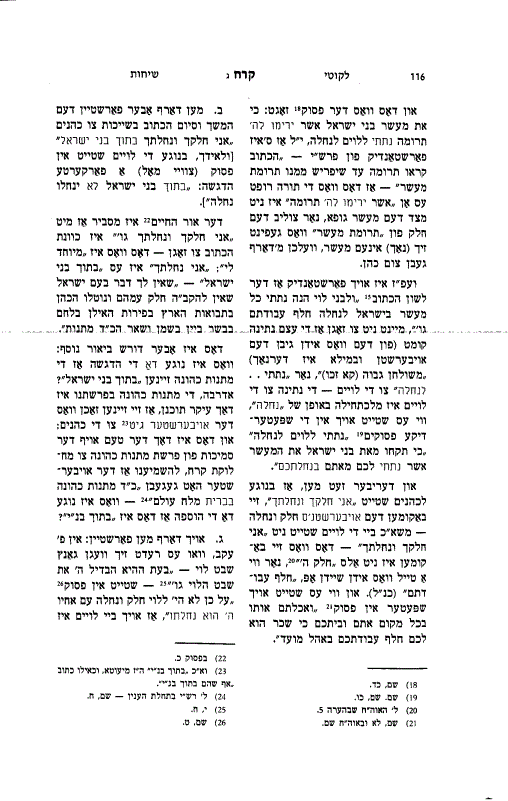
According to Rashi's commentary one may say that the verses (both in Parshas Eikev and in Parshas Shoftim) speak about kohanim. On the verse "Therefore Levi had no portion or inheritance with his brothers," Rashi explains: "לפי שהובדלו לעבודת מזבח ואינן פנויין לחרוש ולזרוע" ("because they were set apart for the service of the altar and are not free to plow and sow"), and "set apart for the service of the altar" is a matter that pertains to kohanim. And likewise in Parshas Shoftim, the beginning of the verse, "לא יהי׳ לכהנים הלוים" ("The kohanim, the Levites, shall not have"), means, according to Rashi, "הכהנים שיצאו משבט לוי" ("the kohanim who descended from the tribe of Levi").
(As he also explains several verses earlier29; from this it is understood that the expression "the kohanim, the Levites" that appears in all the other places also means "the kohanim who descended from the tribe of Levi," and Rashi need not explain it again.)
And the continuation of the wording, "the whole tribe of Levi," Rashi explains as "בין תמימין בין בעלי מומין" ("whether unblemished or blemished") — that is, the verse here does not include the entire tribe of Levi, but rather "whether unblemished or blemished" among the kohanim.
And so Targum Yonasan explains in Parshas Shoftim30, that the verses speak about kohanim.
However, from the fact that the Torah nevertheless uses in both places the expression "tribe of Levi" — "At that time G‑d set apart the tribe of Levi," "the whole tribe of Levi" [and in both passages there are matters pertaining to the Levites: in Parshas Eikev — "לשאת את ארון ברית ה׳" ("to carry the Ark of the Covenant of G‑d"), which Rashi explains as "הלוים" ("the Levites"); and in Parshas Shoftim — "אשי ה׳ ונחלתו יאכלון" ("they shall eat the fire-offerings of G‑d and His inheritance") — "אלו קדשי הגבול תרומות ומעשרות" ("these are the holy things of the provinces, terumos and tithes")] — it is understood that although primarily the kohanim are meant here, the Levites are nevertheless also included in this.
This requires explanation: what is the reason for the difference and change emphasized in the verses of our parsha, that regarding the kohanim it says "I am your portion and your inheritance among the Children of Israel," whereas this is not so regarding the Levites?
4. There is a further matter requiring explanation: The Rambam — in the manner of (and according to) halachah — explains that the verses in our parsha and in Parshas Shoftim refer to the entire tribe of Levi. In his words31: "כל שבט לוי מוזהרין שלא ינחלו בארץ כנען כו׳ שנאמר לא יהי׳ לכהנים הלוים כל שבט לוי . . בארצם לא תנחל כו׳" ("The entire tribe of Levi is warned not to take an inheritance in the land of Canaan, etc., as it says: 'The kohanim, the Levites, the whole tribe of Levi, shall not have . . . In their land you shall not inherit,' etc."). And in continuation of this he says32: "ולמה לא זכה לוי בנחלת א״י כו׳ מפני שהובדל כו׳ והוא ב״ה זוכה להם שנאמר אני חלקך ונחלתך" ("And why did Levi not merit a share in the inheritance of the Land of Israel, etc.? Because he was set apart, etc., and He, blessed be He, provides for them, as it says: 'I am your portion and your inheritance'").
It is indeed obvious that one cannot pose a question on the Rambam from the plain meaning of the verses; nevertheless, it is worth examining what the difference is between Rashi's view (according to the plain meaning of the verses) and the Rambam's view (according to halachah).
5. One may explain this by first noting that the difference between kohanim and Levites can be understood in two ways:
a) Both, the Levites as well as the kohanim, are distinguished from (are higher than) all Jews in one and the same manner, in general — they are set apart and separated from the community of Israel; only within this itself, the kohanim are more set apart to G‑d than the Levites.
b) Kohanim and Levites are two separate categories in being set apart to G‑d.
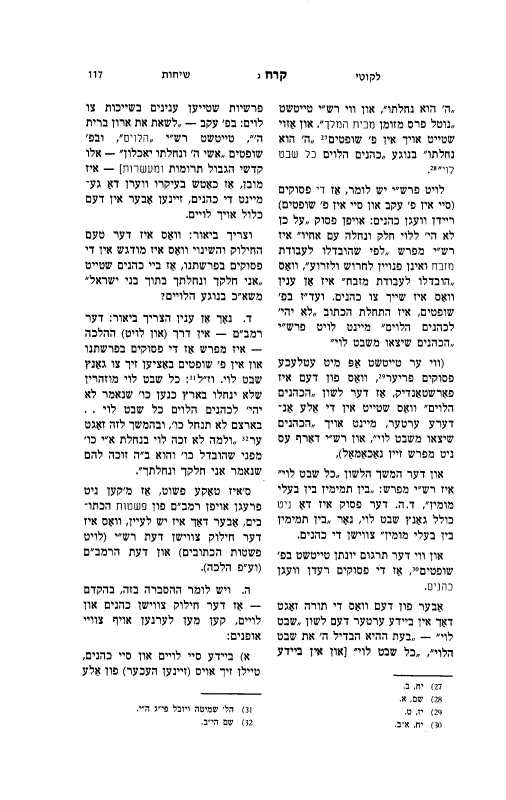
The explanation of this:
The setting apart of the kohanim was stated at the beginning of Parshas Tetzaveh33: "ואתה הקרב אליך את אהרן אחיך גו׳" ("And you, bring near to you Aharon your brother, etc."), together with and in continuation of the work of the Mishkan; whereas the Levites' being set apart for the service of the Mishkan is stated in the Torah for the first time in Parshas Bamidbar34, after the erection of the Mishkan, and moreover — the command was35: "הקרב את מטה לוי והעמדת אותו לפני אהרן הכהן ושרתו אותו" ("Bring near the tribe of Levi and present it before Aharon the kohen, and they shall serve him")36.
It follows that according to the plain meaning of the verses there is a fundamental difference in the category of service between kohanim and Levites:
The kohanim — the term kehunah meaning service37 — were chosen as the servants of G‑d in the Mishkan, "לכהנו לי" ("to serve Me as kohen")38; "לקדשו לכהנו לי" ("to sanctify him to serve Me as kohen")39.
Whereas the Levites are not in the category of servants of G‑d directly, but rather "and they shall serve him," "מסייעין" ("assisting")40 the kohanim — "זו היא השירות" ("this is the service")40. Moreover: all their tasks in the Mishkan, even those which visibly were not seen to be an assistance to the kohanim, are called "משמרת בני ישראל" ("the charge of the Children of Israel")41, and Rashi explains: "שכולן היו זקוקין לצרכי המקדש אלא שהלוים באים תחתיהם בשליחותם לפיכך לוקחים מהם המעשרות בשכרן" ("for all of them were obligated in the needs of the Sanctuary, but the Levites come in their place as their agents; therefore they take the tithes from them as their wages") — they were like hired agents of the Children of Israel42.
In other words: according to Rashi's commentary on the plain meaning of Scripture it emerges that G‑d set apart the kohanim in the manner that He designated them as His servants; the Levites G‑d singled out so that the Jews should hire them — "שיהיו ישראל שוכרין אותן לשירות שלי" ("that Israel should hire them for My service")43.
The Rambam, however, says in Laws of the Vessels of the Sanctuary44: "זרע לוי כולו מובדל לעבודת המקדש שנאמר בעת ההיא הבדיל ה׳ את שבט הלוי" ("The entire seed of Levi is set apart for the service of the Sanctuary, as it says: 'At that time G‑d set apart the tribe of Levi'"). Afterwards, in a separate chapter, the Rambam says45: "הכהנים הובדלו מכלל הלוים לעבודת הקרבנות שנאמר ויבדל אהרן להקדישו קדש קדשים" ("The kohanim were set apart from the general body of the Levites for the service of the offerings, as it says46: 'And Aharon was set apart to sanctify him as holy of holies'"). That is, the Rambam's view is like the first way mentioned above: the same setting apart applies to both; the difference is only whether it is for the service of the Sanctuary or for the service of the offerings.
6. Accordingly, the difference between Rashi's view (in the plain meaning of Scripture) and the Rambam's view in his Yad (according to halachah) is twofold:
a) According to Rashi, there is in the Torah a separate setting apart and drawing near to G‑d of the kohanim from among the Children of Israel — not bound up with their being set apart as the tribe of Levi; whereas according to the Rambam (in halachah), there is first the general setting apart of the entire tribe of Levi (including the kohanim), and (afterwards — within this itself) "the kohanim were set apart from the general body of the Levites"47.
b) According to Rashi, these are two separate categories (types) of service: for a kohen, service is something essential (in him); this is his very name — "kohen" means service, and — service to G‑d. For a Levi, however, his service is not (directly) to G‑d, but service subordinate to ("וילוה אליך" — "and they shall be joined to you") the kohanim; and — his service is not an essential matter, but rather he is a person who has been hired.
Whereas according to the Rambam, both are in the same general category of service48, and the difference between them is only that "the entire seed of Levi is set apart for the service of the Sanctuary" in general, and "the kohanim were set apart from the general body of the Levites for the service of the offerings"49.
7. From this it is understood regarding our parsha, that after the dispute of Korach, when there was "a challenge to the priesthood"50 and the order of the priesthood and the Levitical service had to be established anew, there is in this, too, a difference between the views of Rashi and the Rambam:
According to Rashi (in the plain meaning of Scripture), this was established in the same manner as before: to the kohanim was the warning "אתה ובניך גו׳ תשאו את עון כהונתכם" ("You and your sons, etc., shall bear the iniquity of your priesthood") ("שאינה מסורה ללוים, ותזהירו הלוים השוגגים שלא יגעו אליכם בעבודתכם" — "which is not entrusted to the Levites; and you shall warn the Levites who err not to touch you in your service"), and regarding the Levites — "וגם את אחיך מטה לוי . . הקרב אתך וילוו עליך וישרתוך" ("And also51 your brothers, the tribe of Levi . . . bring near with you, and they shall be joined to you and serve you")52 (and similarly, in the verses that follow in the passage, the differences between the services of the kohanim and the Levites are enumerated in detail: "אל כלי הקודש ואל המזבח לא יקרבו ולא ימותו גם הם גם אתם" ("they shall not come near the holy vessels and the altar, that they not die, both they and you"), but rather "ונלוו (הלוים) עליך" ("and they (the Levites) shall be joined to you")53).
Whereas according to the Rambam, one learns from the verses that "כשם שהלוים מוזהרין שלא לעבוד עבודת הכהנים כך הכהנים מוזהרין שלא לעבוד עבודת הלוים שנאמר גם הם גם אתם" ("just as54 the Levites are warned not to perform the service of the kohanim55, so are the kohanim warned not to perform the service of the Levites, as it says56: 'both they and you'"). For although the kohanim were initially set apart together with the entire tribe of Levi, nevertheless, since they were set apart with a special setting apart also from the general body of the Levites, they may not perform the service of the Levites.
[This, however, is only according to the Rambam, that both are a category of service; whereas according to Rashi (in the plain meaning of Scripture) one may say that we do not find that kohanim are warned against performing the service of the Levites57, because this is not within that category; the name "service" for the Levites is an entirely different category (similar to the Gemara's expression58, "דלאו מינה לא מחריב בה" ("what is not of its kind does not damage it")59)]60.
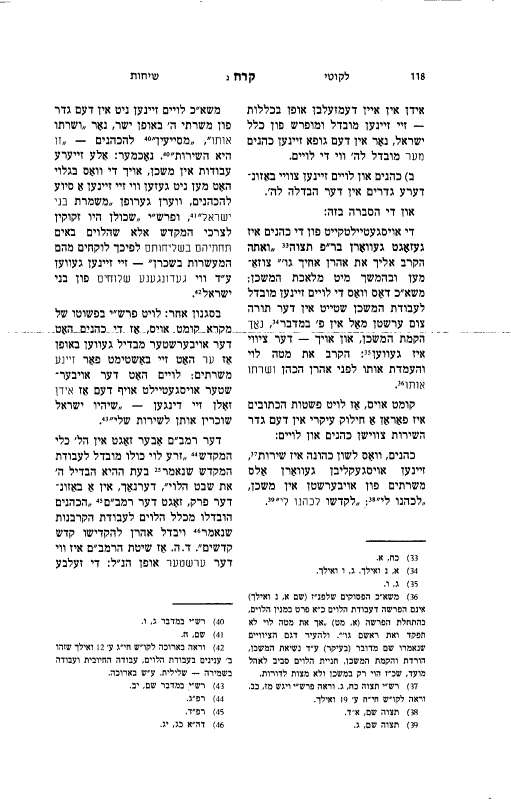
8. Accordingly, it is understood that each follows his own view regarding the continuation of the passage of the priestly gifts, where the Torah concludes regarding the priesthood that it is "ברית מלח עולם" ("an everlasting covenant of salt"):
According to Rashi (in the plain meaning of Scripture), the matter of "I am your portion and your inheritance" was said only to the kohanim, because since their function is service to G‑d, accordingly they also receive the gifts in the manner of "I am your portion, etc." — "from the table of the Most High they acquire."
Whereas the Levites, who are in the category of (not actual "servants of G‑d," but) "and they shall be joined to you and serve you" and "agents of the Children of Israel," therefore their gifts too are of the type of (not "I am your portion and your inheritance," but) "a tithe in exchange for their service"61.
According to the Rambam, however, since kohanim and Levites are both together set apart for service — from the outset "the entire seed of Levi is set apart" (and only afterwards "the kohanim were set apart from the general body of the Levites") —
— the Levites, too, are in the category of service to G‑d, and consequently they too are included in "I am your portion and your inheritance."
9. Accordingly, it is also understood regarding the passages in Mishneh Torah (in Parshas Eikev and Shoftim), that the difference between Rashi and the Rambam is in keeping with their earlier interpretations:
According to the Rambam, the Levites too are included in the passage "At that time G‑d set apart the tribe of Levi" in Parshas Eikev, and "The kohanim, the Levites, the whole tribe of Levi, shall not have" in Parshas Shoftim62, because the setting apart to G‑d includes the entire tribe of Levi.
But according to Rashi (in the plain meaning of Scripture), since in its own place (in Parshas Bamidbar and in our parsha) it is clear (in the plain meaning of Scripture) that there is a difference between the category of service of the kohanim and that of the Levites, it is not reasonable that (in the above verses, "At that time, etc." and "The kohanim shall not have, etc.") in Mishneh Torah (which, as its name implies, consists of matters that Moshe Rabbeinu repeated to the Jews) the Torah should state a new category regarding kohanim and Levites. Rashi therefore learns that this is spoken in a general manner, and "G‑d is his inheritance" speaks primarily about kohanim.
[One may further say that according to Rashi, the two verses in Parshas Eikev are separate matters:
"בעת ההיא הבדיל ה׳ את שבט הלוי לשאת את ארון ברית ה׳ לעמוד לפני ה׳ לשרתו ולברך בשמו עד היום הזה" ("At that time G‑d set apart the tribe of Levi to carry the Ark of the Covenant of G‑d, to stand before G‑d to serve Him and to bless in His name, to this day") — the reason the Torah combines together the Levites, who carry the Ark of the Covenant of G‑d, and the kohanim — "to stand before G‑d to serve Him and to bless in His name" — is because here it is not speaking about the essential service of the kohanim. For this reason Rashi's explanation on the first verse is all the more understandable63, that "to stand before G‑d to serve Him and to bless in His name" means "נשיאת כפים" ("the raising of the hands")64, not their service and avodah in the Sanctuary, which is their principal function.
And the second verse, "על כן לא הי׳ ללוי חלק ונחלה עם אחיו ה׳ הוא נחלתו כאשר דבר ה׳" ("Therefore Levi had no portion or inheritance with his brothers; G‑d is his inheritance, as G‑d spoke"), Rashi explains as a matter in its own right: "because they were set apart for the service of the altar," which is the principal service of the priesthood — and therefore it says here, "G‑d is his inheritance"65 — "he takes a ready allowance from the king's house."]
10. In light of all this, one can explain according to Rashi the difference between kohanim and Levites in our parsha — that regarding the kohanim it says "I am your portion and your inheritance among the Children of Israel," whereas regarding the Levites it says (seemingly the opposite) "Among the Children of Israel they shall not inherit an inheritance." In this consists the difference between the inheritance of the kohanim and the inheritance of the Levites:
The inheritance of the kohanim is "among the Children of Israel" — together with (in the same manner as) the Jews' having an inheritance: just as G‑d gave the Jews, to the Jews, an inheritance — the Land of Israel — so too G‑d gave a portion and inheritance to the kohanim: "all the terumos of the holy things which the Children of Israel set apart for G‑d"66.
Whereas the Levites did not receive an inheritance (directly) from G‑d — as the Jews received an inheritance, the Land of Israel — rather, G‑d commanded that the Jews should give the children of Levi wages, "in exchange for their service." And this is what the Torah emphasizes: "ובתוך בני ישראל לא ינחלו נחלה" ("And among the Children of Israel they shall not inherit an inheritance") — their inheritance is not together with (and in the same manner as) the Jews' having an inheritance67.
11. From the "יינה של תורה" ("wine of the Torah") in Rashi's commentary:
The Rambam says68: "לא שבט לוי בלבד אלא כל איש ואיש כו׳ אשר נדבה רוחו כו׳ לעמוד לפני ה׳ כו׳ הרי זה נתקדש קדש קדשים ויהי׳ ה׳ חלקו ונחלתו" ("Not only the tribe of Levi, but every single person, etc., whose spirit moves him, etc., to stand before G‑d, etc. — such a person has become sanctified as holy of holies, and G‑d will be his portion and his inheritance").
From this it is understood, also according to Rashi's view of the category of kohen and Levi, that in each and every person, in spiritual avodah, there is both the level of kohen and the level of Levi. And since in the Time to Come the Levites will become kohanim — the Levites will be higher than the kohanim69 — it is understood that also in the present time there is a quality in a Levi relative to a kohen.
One may explain this according to the above: "Levi" derives from the term "ילוה" ("will be joined"), connection and attachment70 — cleaving to G‑d71. On the other hand, it is said, "they shall be joined to you and serve you" — that they are servants to the kohanim and their assistants, and moreover — agents of the Children of Israel to serve.
Seemingly, how do the two matters fit together? Since their function is connection and attachment to G‑d, they should have been like the kohanim, servants of G‑d, "to sanctify him to Me," "sanctified as holy of holies"!
The explanation of this, however, is that this itself is the reason: the true meaning of the service of G‑d is when one is no independent existence whatsoever.
The Children of Israel, who have an inheritance given to them by G‑d, and likewise the kohanim, of whom it is said "I am your portion and your inheritance among the Children of Israel," are all servants of G‑d — and this in itself means that they are within a certain category of existence;
whereas the Levites72 do not feel themselves at all as an existence (in their own right) — not even as an existence of holiness; they are not even an existence of servants of G‑d (but only assistants to the kohanim (so that the other can perform his service), and hired agents of the Jews) — and precisely in this avodah, of complete self-nullification73, there comes about the true "ילוה אישי אלי" ("my husband will become attached to me")74, the connection and attachment between the Jews and G‑d.
(From the sichos of Shabbos Parshas Korach 5745, and Shabbos Parshas Nitzavim-Vayeilech and 29 Elul 5744)
Notes
1) 18:8ff.
2) Ibid., 20.
3) Ibid., 21 (ff.).
4) Ibid., 23, 24.
5) And as the Ohr HaChaim writes on the verse — ibid., 24.
6) Ibid., 8.
7) Ibid., 9–10.
8) Ibid., 11 (and Rashi there); 15; and elsewhere.
9) Ibid., 12–13.
10) See Rashi there, 9: "Which they shall return to Me — this is the robbery of a convert." And Rashi on Parshas Naso (5:8): "G‑d acquired it and gave it to the kohen."
11) See Rashi there, 19.
12) Ibid.
13) Beitzah 13a, beginning; ibid., 12b; and the sources cited there.
14) See Rambam, Laws of Terumos (12:19), regarding terumos (and see also Yad Ramah, Sanhedrin 112a). And in the Sifri on our parsha (18:21): "All the priestly gifts — G‑d acquired them and gave them to the priesthood, etc." And there, before this (on 18:20): "At My table you eat and at My table you drink, and so it says, etc." And see Responsa of the Rashba (vol. 1, sec. 8) and elsewhere, that no blessing is recited over the priestly gifts because they acquire them from the table of the Most High. And see Likkutei Sichos vol. 8, p. 223ff., and the sources cited there.
15) Our parsha, ibid., 21.
16) That they serve in place of the Children of Israel, for "they are given to him from the Children of Israel" for this purpose (Bamidbar 3:8–9). And see below, section 5.
17) And see also Rashi's commentary cited below, section 5. And so it is according to the view of Rabbi Yoshiyah in the Sifri there, that all twenty-four priestly gifts G‑d acquired and gave to the priesthood, whereas this (regarding the Levites) is "in exchange for their service." According to Rabbi Yonasan, also regarding the Levites G‑d acquired it and gave it to the Levites — see the commentators on the Sifri: Rabbeinu Hillel, Toldos Adam, Sifri D'Vei Rav. And see note 61.
18) Ibid., 24.
19) Ibid., ibid., 26.
20) [OCR unclear] cited in note 5.
21) Ibid., 31, and in Ohr HaTorah there.
22) In verse 20.
23) [OCR unclear]
23*) And if so, "among the Children of Israel" would be a limitation, as if it were written, "even though they are among the Children of Israel."
24) The wording of Rashi at the beginning of the topic — ibid., 8.
25) 10:8.
26) Ibid., 9.
27) [OCR unclear], 2.
28) Ibid., 1.
29) 17:9.
30) 18:1–2.
31) Laws of Shemittah and Yovel 13:10.
32) Ibid., 13:12.
33) 28:1.
34) 1:50ff.; 3:6ff.
35) 3:6.
36) In contrast, the preceding verses (there, 1:50ff.) are not the passage of the service of the Levites, but only a detail in the counting of the Levites, as at the beginning of that passage (1:49): "But the tribe of Levi you shall not count, and their total, etc." Note also that the commands stated there speak (mainly) about carrying the Mishkan, taking down and erecting the Mishkan, and the encampment of the Levites around the Tent of Meeting, all of which applied only to the Mishkan and is not a mitzvah for all generations.
37) Rashi, Tetzaveh 28:3. And see Rashi, Vayigash 47:22. And see Likkutei Sichos vol. 18, p. 19ff.
38) Tetzaveh, ibid., 1–4.
39) Tetzaveh, ibid., 3.
40) Rashi, Bamidbar 3:6.
41) Ibid., 8.
42) And see at length Likkutei Sichos vol. 13, p. 12ff., that these are two aspects in the service of the Levites: active service, and service by guarding — a negative [service]. See there at length.
43) Rashi, Bamidbar, ibid., 12.
44) Beginning of ch. 3.
45) Beginning of ch. 4.
46) I Divrei HaYamim 23:13.
47) Note the discussion as to whether a kohen possesses the holiness of a Levi. Seemingly, one may say that this relates to the dispute between Rashi and the Rambam discussed in the text. And see Chikrei Lev, Orach Chaim, sec. 38. And see below in the text. This is not the place to elaborate.
And note Tzafnas Paneach, Mahadura Tinyana, at its end (p. 182), and in several places, where he explains that our Gemara and the Yerushalmi disagree whether a kohen who became a chalal has the status of a Levi. And see Tzafnas Paneach on the Torah, our parsha 18:21, and the sources cited there.
48) And note the Alter Rebbe's Shulchan Aruch, Orach Chaim, sec. 128, section 10 (and the sources cited there), that the custom that a Levi pours water over the hands of the kohanim is so that the kohanim add holiness to their holiness. And see there, section 11, regarding a Levi who is a Torah scholar and a kohen who is unlearned: "And there is no prohibition in this on account of disgrace to his Torah, since he does not serve the kohanim by way of the statute and law of the priesthood, but intends to add holiness, etc."
49) On the general difference between a kohen and a Levi — see, in a different vein, Likkutei Sichos vol. 8, p. 192ff.; vol. 9, p. 316ff.; and elsewhere.
50) The wording of Rashi on our parsha, 18:8.
51) This is incumbent upon the kohen to do.
52) 18:1–2, and Rashi there.
53) 3–4. See Rashi there.
54) Ibid., 3:10.
55) One may say that there is a fundamental difference between this warning and the warning that a gatekeeper not sing, etc., among the Levites themselves (Arachin 11b; Sifri on our parsha, 18:13; Rambam, ibid., 3:10). Among the differences: a) In the services of kohanim or of Levites — one who performs the service of the other is a zar (an outsider) (and perhaps one may say that the same applies to the Yisrael who is part of the maamad)* — whereas for a gatekeeper and a singer it is merely forbidden (not on account of being an outsider). b) The object is different — the Sanctuary, or the offering. And there are other differences. And note [OCR unclear] (HaMelukat) on Sefer Avodah, there. This is not the place to elaborate.
*) And note the discussion in Minchas Chinuch, mitzvah 389 (cited below, note 60).
56) Our parsha, ibid., 3.
57) And see Chikrei Lev, ibid., at the beginning.
58) Zevachim 3a, and Rashi there; ibid., 3b.
59) In contrast, regarding a gatekeeper and a singer (note 55), one may say that even according to the plain meaning of Scripture it is forbidden.
60) Note (regarding halachah) the Minchas Chinuch (mitzvah 389), that this warning, that the Levites not engage in the service of the kohanim and likewise the reverse, "applies only to the two families, kohanim and Levites, etc., but Yisraelim are not included in this warning, and regarding a Yisrael who sings or serves as gatekeeper we have not found any prohibition at all." This requires great examination, for a Yisrael who sang or served as gatekeeper would be an outsider and liable to death, etc., as is explicit in Arachin there (and in Rashi there).
61) Note that even according to the views regarding halachah that for the kohanim, too, it was "in exchange for their service" (see Or Zarua vol. 1, sec. 113; and elsewhere), kohanim differ from Levites: for the Levites it was that Israel hires them and gives them a tithe in exchange for their service, as Rashi puts it in Parshas Bamidbar (as cited above in the text, section 5); whereas for the kohanim it was what the Holy One, blessed be He, gives them in exchange for their service to Him. And see Rashi's wording, Arachin 34a, s.v. Hacha birshuso. And see Yad Efraim, Yoreh De'ah, sec. 61, section 9; Responsa Beis Yitzchak, [OCR unclear], para. 14; and elsewhere. This is not the place to elaborate.
62) See Rambam, ibid., halachah 2 (from Arachin 11a): "As it says (Shoftim 18:7): 'And he shall serve in the name of G‑d his G‑d, like all his brothers the Levites' — which service is in the name of G‑d? You must say: this is song." But in Rashi on Shoftim there (6–7, from the Sifri on the verse), it refers to a kohen and not a Levi, for "the Levites are excluded, since they are not fit for this service."
63) Even though this is compelled regardless, from what is written, "and to bless in His name." But see the next note.
64) For from the fact that Rashi copied in the caption not only the words "and to bless in His name" but also "to stand before G‑d to serve Him," it is implied that he interprets these words, too, as referring to the raising of the hands (or, that the main point here is the raising of the hands). This requires further examination.
65) But one may say that since regarding the Levites it is said "and they shall serve him" — that they assist the kohanim in the service of the altar — therefore, in general, the Levites too are included in the second verse, "Therefore Levi had no, etc. . . . G‑d is his inheritance." However, the verse concludes "as G‑d spoke to him," and the intent, seemingly, is to the verse in our parsha regarding the kohanim. And it requires examination why Rashi did not explain this on this verse (in Parshas Eikev), but only afterwards, in Parshas Shoftim 18:2 (at its end).
66) Our parsha 18:19.
67) And also the forty-eight cities given to the Levites — according to the plain meaning of Scripture they are not an inheritance for them among the Children of Israel, but rather, as the verse puts it (Masei 35:2–3): "And they shall give to the Levites, from the inheritance of their holding, cities to dwell in . . . and the cities shall be . . . to dwell in" (see Ohr HaChaim there). And see Ramban on our parsha, at its end; below, p. 217. Regarding halachah — see Yerushalmi, Maaser Sheni 5:9; and at length Likkutei Sichos vol. 25, p. 93ff., and the sources cited there.
68) At the end of Laws of Shemittah and Yovel. And see Likkutei Sichos vol. 8, p. 345ff.; vol. 8, p. 194; and the sources cited there.
69) Tanya, ch. [OCR unclear]; [OCR unclear] of the Arizal (Yechezkel). And see at length Likkutei Torah, our parsha, 54b, bottom, ff.
70) As written in Parshas Vayeitzei (29:34).
71) See Torah Or, Vayechi 45b, bottom, ff.; and in several places.
72) See Torah Or, Beshalach 62c.
73) See similarly Likkutei Sichos vol. 22 (p. 12ff.) — that specifically in the donation of the wood, which is not part of the offering itself but only a preparation for the offering (and consequently a person does not have the "satisfaction" of having effected the "pleasing fragrance to G‑d," and all his action is only that he assists another to bring his offering), self-nullification and self-sacrifice for G‑d come more openly to the fore.
74) Vayeitzei, ibid.
Key Lesson
The kohen serves G‑d directly, while the Levi serves only as an assistant to the kohen and as a hired agent of the Jewish people. Yet precisely because the Levi does not feel himself as an existence at all, not even an existence of holiness, his complete self-nullification brings about the truest attachment to G‑d. Every Jew has both the kohen and the Levi within his spiritual avodah.