



Parshas Shemini
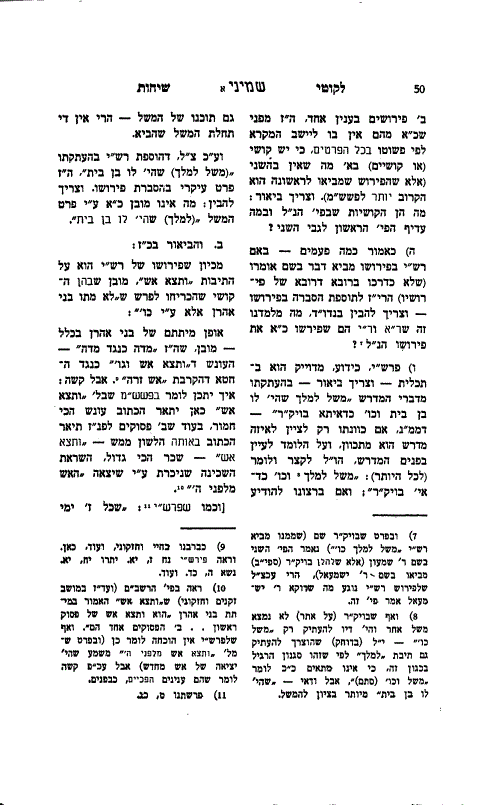
1. In his commentary on the verse1 "ותצא אש מלפני ה' ותאכל אותם וגו'" ("And fire went out from before G‑d and consumed them, etc."), Rashi copies the words "ותצא אש" ("And fire went out") and explains: "Rabbi Eliezer says: The sons of Aharon died only because they rendered a halachic ruling in the presence of Moshe their teacher. Rabbi Yishmael says: They entered the Sanctuary intoxicated with wine. Know this,2 for after their death He warned those who remained that they should not enter the Sanctuary intoxicated with wine. This is comparable to a king who had a member of his household, etc., as is stated in Vayikra Rabbah."3
This needs to be understood:
a) The reason for the death of Aharon's sons is stated explicitly — according to the plain meaning of Scripture — in the text (in the preceding verse): "ויקריבו לפני ה' אש זרה אשר לא צוה אותם" ("They brought before G‑d a strange fire, which He had not commanded them"); "(therefore) ותצא אש גו' וימותו גו'" ("fire went out... and they died..."). No explanation at all is needed.
b) Nevertheless, Rashi does explain it — yet not according to the plain meaning of Scripture, but rather with an explanation that apparently has no connection whatsoever to the meaning of the verses.4
c) Since Rashi comes to explain the reason why "the sons of Aharon died," he should have copied in his commentary the word "וימותו" ("and they died"),5 to which the explanation refers — and not "And fire went out."6
d) It is a known rule that when Rashi brings two explanations of one matter, it is because neither of them on its own suffices to settle the verse according to its plain meaning in all its details, for there is a difficulty (or difficulties) in one that is not in the other (except that the explanation he brings first is the one closer to the plain meaning of Scripture). This needs clarification: what are the difficulties in each of the above explanations, and in what way is the first explanation preferable to the second?
e) As has been stated several times, when Rashi in his commentary cites something in the name of the one who said it (which is not his practice in the overwhelming majority of his comments), this serves to add to the explanation in his commentary. We must therefore understand, in our case: what does it teach us that it was Rabbi Eliezer and Rabbi Yishmael who each offered his respective explanation?7
f) Rashi's commentary, as is known, is precise to the utmost degree. Clarification is therefore needed regarding his quotation from the words of the Midrash, "This is comparable to a king who had a member of his household, etc., as is stated in Vayikra Rabbah." For either way: if his intention is only to indicate which Midrash he means, and the student must look into the text of the Midrash itself, he should have been brief and said (at most): "This is comparable to a king, etc., as is stated in Vayikra Rabbah";8 and if he wishes to convey also the content of the parable — the opening of the parable that he cites is not sufficient.
We must therefore say that Rashi's addition in his quotation, "(This is comparable to a king) who had a member of his household," is an essential detail in explaining his commentary. And we must understand: what is it that can be understood only through this detail of the parable, "(a king) who had a member of his household"?
2. The explanation of all this:
Since Rashi's comment is on the words "And fire went out," it is understood that it is in these words that the difficulty lies which compelled him to explain that "the sons of Aharon died only because of etc.":
The manner of the death of Aharon's sons in general is understandable: it is "measure for measure"9 — the punishment of "And fire went out, etc." corresponds to the sin of offering "a strange fire." But there is a difficulty: how is it possible to say, according to the plain meaning of Scripture, that with the words "And fire went out" here the verse describes a most severe punishment, when just two verses earlier the verse described, in exactly the same words — "And fire went out" — the greatest reward, the resting of the Shechinah, which was made manifest when "fire went out from before G‑d"?10
[As Rashi explains:11 "For all the seven days of the inauguration . . . the Shechinah did not rest in it (in the Mishkan), and the Jewish people were ashamed . . . (Moshe) said to them . . . my brother Aharon is worthier . . . that through his offerings and his service the Shechinah will rest among you, etc." — "And fire went out, etc.," and then "the entire people saw, and they sang praise and fell upon their faces."]
This is what compelled Rashi to explain that the "And fire went out" stated regarding the death of Aharon's sons is also a matter of (a semblance of) the resting of the Shechinah, a revelation of holiness: just as through Aharon's service came the revelation of "And fire went out . . . upon the altar," so too through the incense offering of Aharon's sons came the revelation of "And fire went out." Only, because there was a deficiency (relative to their standing and stature) in the manner of their conduct in this service, therefore "it consumed them, and they died, etc." But the service in itself was a holy service.
This is what Rashi writes: "The sons of Aharon died not (through the service itself) but because they rendered a halachic ruling (this one, of offering the fire) in the presence of Moshe their teacher." This does not contradict what is stated, "a strange fire, which He had not commanded them." On the contrary, this wording implies that their offering was "a strange fire" (only because) "He had not commanded them" (the sons of Aharon) — rather, they commanded it to themselves;12 but the matter itself was not contrary to the command. Nevertheless it is called "a strange fire," similar to what is stated,13 "a strange incense" — strange to him.
However, it is somewhat difficult to say that for this such a severe punishment would come — and Rashi alludes to the answer by saying that the author of this explanation is Rabbi Eliezer:
Lofty and wondrous praises were said about Rabbi Eliezer, describing the greatness of his power and his wisdom in Torah.14 Yet Rabbi Eliezer said:15 "One who says something he did not hear from his teacher causes the Shechinah to depart from Israel." From this one can understand, all the more so and by a kal vachomer, how severe the matter is when (not only does one "say something he did not hear from his teacher," but) one says it in the presence of his teacher. Accordingly, it is understood why the sons of Aharon were punished with such a severe punishment.
3. However, this explanation is still not entirely settled, for there is a difficulty from the opposite direction: since in offering the incense they rendered a halachic ruling in the presence of their teacher, and thereby caused the Shechinah to depart, as above — how is it possible that through this "fire went out," (a semblance of) the resting of the Shechinah, as above?
Because of this difficulty Rashi brings a second explanation: "They entered the Sanctuary intoxicated with wine." According to this, the matter concerns a warning about which they had not yet been commanded; and if so, the offering of the incense was complete, without any transgression of G‑d's command — and it is understood why through this offering "fire went out" — (a semblance of) the resting of the Shechinah, as above.
This is why Rashi continues his explanation and says: "Know this, for after their death He warned those who remained that they should not enter the Sanctuary intoxicated with wine." His intention in this is [not only to infer that since, in the middle of the account of the service of the eighth day, immediately after the death of Aharon's sons, the verse interrupts with the warning "Wine and strong drink do not..." — this implies that the cause of their punishment is connected with the subject of this warning; but also] to explain the advantage of this explanation (over the first), as stated above: according to Rabbi Yishmael, the sons of Aharon did not transgress G‑d's command in their offering, for they had not yet been commanded about this, and only "after their death He warned those who remained, etc."
One should not raise a difficulty from what is stated as a preface to the punishment, "which He had not commanded them" — for "them" emphasizes: as opposed to others. Since it is obvious that Nadav and Avihu, Aharon's eldest sons, who were inaugurated and anointed together with him, were certainly the closest to him in stature, as it is written,16 "Go up to G‑d, you (Moshe) and Aharon, Nadav and Avihu, and seventy of the elders of Israel" — we must say that at that time there was a diminution in their stature: they were intoxicated with wine.
However, according to this explanation there is a difficulty: why were they punished (and especially with such a severe punishment) when they had not been commanded about this? Rashi answers: "This is comparable to a king who had a member of his household, etc., as is stated in Vayikra Rabbah."
The words of the Midrash there are: "This is comparable to a king who had a trusted*16 member of his household. He found him standing at the entrance of taverns, and silently cut off his head, and appointed another member of the household in his place. We would not know why he killed the first, except that he commands the second, saying, 'Do not enter the entrance of taverns' — from this we know that it was because of this that he killed the first."
From the words of the Midrash it is understood that although the first had not been commanded about this, nevertheless, since he was a "member of the household" of the king, he should have understood on his own, even without an explicit warning, that this is contrary to the king's will.
This is what Rashi alludes to here by quoting the opening of the Midrash's words — "This is comparable to a king who had a member of his household" — for this resolves the question why the sons of Aharon were punished for something about which they had not been commanded, as above. For they were "members of the household" of the Holy One, blessed be He (as it is written, "בקרובי אקדש" ("I will be sanctified through those near to Me")17), and they know of their own accord the conduct of His household, even when they have not been explicitly commanded about it.
Nevertheless, it is still not fully settled to say that the sons of Aharon would be punished with a severe death for something about which they had not been commanded. Rashi therefore adds that it was Rabbi Yishmael who explained it this way.
For our Sages said about Rabbi Yishmael:18 "A Kohen (for Rabbi Yishmael was a [High] Kohen19) assists Kohanim" (Rashi explains: "He always helps them and is lenient with them"). And he follows his own approach in our case: Rabbi Yishmael preferred to "assist Kohanim" and to "be lenient" regarding the sin of the sons of Aharon, the Kohanim, even if this is somewhat forced as an explanation of the verses, rather than to explain the verses in a manner that (is more settled, but) magnifies their sin — that is, to say that they transgressed the command of the Holy One, blessed be He, and rendered a halachic ruling in the presence of their teacher.
4. However, after all the above, one can raise difficulties about this explanation (in Rashi):
a) The wording of the verse, "They brought... a strange fire," implies that the "strangeness," the sin, was in the offering itself, and not only on account of those offering it, namely that they were intoxicated with wine when they offered it;20
b) Since the sin was not in the offering by means of fire, why (and consequently — what difference does it make, that the verse tells us that) were they punished through "And fire went out"?21
Therefore Rashi is not satisfied with this explanation. On the contrary, from the fact that he brings it as the second explanation it is understood that the first explanation — although it, too, is not entirely settled — is closer to the plain meaning of the verses (because of the above difficulties), and therefore it is the first and principal one.
5. Of the halachic matters in this comment of Rashi:
Rashi is precise and says (and so it is in the Gemara22): "that they rendered a halachic ruling in the presence of Moshe their teacher." Seemingly, what difference does it make that the halachic ruling was in the presence of Moshe? It would have been sufficient to say: "that they rendered a halachic ruling in the presence of their teacher."
Even more difficult: seemingly there was in this a sin more severe than rendering a halachic ruling in the presence of Moshe their teacher — namely, that they rendered a halachic ruling in the presence of Aharon, who was their teacher22* and also their father,23 thereby impinging upon his honor.24 This is especially so since the act of the incense pertained to Aharon, as Rashi explained earlier on the verse,25 "ויבא משה ואהרן וגו'" ("Moshe and Aharon came, etc."): "Moshe entered with Aharon to teach him about the procedure of the incense." It follows that their burning the incense themselves was an infringement upon Aharon's service on that day — an infringement upon an explicit command in the plain meaning of Scripture (and in the Ten Commandments): "Honor your father." Accordingly, the difficulty is not only the superfluous word "Moshe" (as above — what difference does it make), but that by this wording Rashi excludes a more severe matter: the infringement upon Aharon's honor.
The explanation of this:
We find in the laws of reclining26 that a student eating in the presence of his teacher, even if he is not his primary teacher, may not recline in his presence, because of awe and honor for the teacher, unless the teacher gave him permission to recline in his presence; but the teacher is under no obligation to give him permission and to forgo his honor. In contrast, a son eating with his father, even if his father is his primary teacher, must recline, because a father presumably forgoes his honor for his son. That is, even where honoring his father (who is his teacher) is more severe than honoring his teacher, the law is that a father presumably forgoes [his honor] for his son, which is not the case with a teacher and his student.
Accordingly, in the case of the sons of Aharon27 as well: although the mitzvah and obligation of honoring their teacher and father (Aharon) is in itself greater than the obligation of honoring their teacher (Moshe), nevertheless the law dictates that when a son (and student) renders a halachic ruling in the presence of his father (and teacher), this is not as severe as a student who renders a halachic ruling in the presence of his teacher, since a father presumably forgoes [his honor] for his son,28 which is not the case with a teacher toward his student.
Accordingly, Rashi's precise wording is understood (in the way of halachah): "in the presence of Moshe their teacher"; whereas for the fact that it was in the presence of Aharon they were not punished, since a father presumably forgoes [his honor] for his son.
Accordingly, one can also appreciate why Rashi quotes also the words "(did not die) the sons of Aharon," though seemingly this is explicit in the verse here. Rather, he wishes to emphasize that since we are dealing with "the sons of Aharon," it is understood that they "died only because they rendered a halachic ruling in the presence of Moshe their teacher," and not in the presence of Aharon their teacher, since a father presumably forgoes [his honor] for his son, as above.
6. From the "wine of Torah" and the lesson for each and every one in this comment of Rashi:
Although the level of Nadav and Avihu was exceedingly lofty — to such an extent that Moshe said to Aharon, "they are greater than me and you," and the Holy One, blessed be He, called them "בקרובי — בבחירי" ("Those near to Me — My chosen ones")29 — nevertheless they were punished with an extremely severe punishment because of the lack of the proper "bittul" (self-nullification) toward their teacher — in that they rendered a halachic ruling in his presence.
And Rabbi Eliezer — despite his great power in Torah, as above — is the one who says that "one who says something he did not hear from his teacher causes the Shechinah to depart from Israel": bittul toward one's teacher is something that affects the revelation of the Shechinah for the Jewish people as a whole.
From this [we learn] that no Jew should say: "I am a scholar and a Torah sage — how can I be nullified before a rav and wait for him to rule for me the halachah in Torah, and likewise in the ways of the world,30 and the path in which I should go in the service of G‑d? Am I not capable of ruling for myself!"
— For who is as great to us as Nadav and Avihu? Yet this was their entire sin: "The sons of Aharon died only because they rendered a halachic ruling in the presence of Moshe their teacher." And to such an extent — that it affects not only themselves,31 but it causes the very opposite of the revelation of the Shechinah among the Jewish people.
On the other hand: it is demanded of each and every one that his Torah study be specifically with understanding and comprehension in his own intellect — to the point that his entire being is permeated with the understanding of Torah.
— And this is why Rashi continues and says, "Rabbi Yishmael says: They entered the Sanctuary intoxicated with wine." Wine represents the level of Binah32 — understanding and comprehension; and "intoxicated with wine" means filled and permeated with understanding and comprehension. The sin was that they entered the Sanctuary in this state. The deficiency of being "intoxicated with wine" applies only at the time of entering the Sanctuary — but a person's service of his Creator when he is not in the Sanctuary must, on the contrary, be with understanding and comprehension.
The Sanctuary represents prayer,33 when a person stands before the King of kings, the Holy One, blessed be He; and "one who gestures before the King, etc."34 — for one must be in utter bittul, "like a servant before his master."35 But his service and toil in Torah must be in the manner of one "intoxicated with wine," his entire being filled and permeated with the intellect of Torah.
— As we find regarding Rabbi Yehudah bar Ilai,36 that a noblewoman told him that his face resembled the face of one intoxicated with wine, and Rabbi Yehudah told her that this was because his learning was readily at hand. That is, the fact that physically he appeared like one intoxicated with wine was because his physical state reflected his spiritual state, and spiritually he was "intoxicated with wine" — permeated with the understanding of Torah. Now, the fact that at the time of prayer (in the Sanctuary) a person nullifies himself completely, as above — this gives strength and brings about that afterward his service in Torah study with his own intellect will also be with the proper bittul,37 while also being with proper understanding and comprehension.38
However, the question arises: how is it possible to join two opposites in Torah study — the learner's sense of his own intellect and understanding, and the nullification of his self, etc.? The answer is given in the continuation of Rashi's comment below: "This is comparable to a king who had a member of his household, etc." Since we are speaking of the Jewish people, who are "members of the household" of the King of kings, the Holy One, blessed be He, He, may He be blessed, gives them the power to join the two opposites,39 so that they can study with understanding and comprehension and at the same time be in the fitting bittul, etc. Through this they will bring about the joining (of the two opposites) of the world and G‑dliness, the world conducting itself according to the halachic ruling of the learner and the conclusion of his study, as our Sages expounded on the verse "לא־ל גומר עלי" ("To G‑d Who completes [it] for me");40 and thereby they hasten the fulfillment of the prophecy, "ונגלה כבוד הוי' וראו כל בשר יחדיו כי פי הוי' דיבר" ("The glory of G‑d shall be revealed, and all flesh together shall see that the mouth of G‑d has spoken"),41 with the coming of our righteous Moshiach.
(From the sichos of Shabbos Parshas Shemini, Shabbos Mevarchim Iyar, 5726)
Notes
1) Our parsha, 10:2.
2) In the first printing, [the text] from here until the end of the comment is absent, and the following comment, "בקרובי — בבחירי" ("Those near to Me — My chosen ones"), ends with "This is comparable to a king, etc."; but in the other printings it is as in the text.
3) Ch. 12:1.
4) In Gur Aryeh here (on the second explanation) he writes that it is certain that they died because they offered a strange fire, but the difficulty is why they died a sudden death, and on this Rabbi Eliezer and Rabbi Yishmael disagree: according to Rabbi Eliezer, the sudden punishment was for rendering a halachic ruling in the presence of their teacher (for this a sudden death came, in keeping with their measure, in that they leapt and hurried to answer in the presence of their teacher); and according to Rabbi Yishmael — because the Sanctuary does not tolerate drunkenness, which is the opposite of holiness. But this is difficult (in addition to the other questions in the text): a) In Rashi it is explicit: "The sons of Aharon died only, etc.," and not because of another matter; and if Rashi's intention were only to the suddenness of the death, the main point is missing from the book. b) There is no compelling reason in the plain meaning of Scripture to say that the Sanctuary does not tolerate drunkenness — and especially to the point of punishing it with death. In Maskil LeDavid he writes that Rashi was troubled why they died specifically through fire, and on this he answered that "they sinned with fire, with which they rendered the halachic ruling, etc." This requires further study, for according to the plain meaning of the verses — that they died because they offered "a strange fire" literally — it is simply understood why they died through fire. Also what he wrote, that Rashi brings Rabbi Yishmael's view because through it the juxtaposition of the passage "Wine and strong drink, etc." to the death of Aharon's sons is understood, is difficult: if so, Rashi should have brought Rabbi Yishmael's explanation at the beginning of that passage — as is his practice in many places — and said, "Why was it juxtaposed, etc."
5) One cannot explain (in a forced way) that Rashi's intention is to the whole verse, only that he copies the words that begin the punishment; for if so he should at least have alluded to the whole verse with "etc." (as in the following comment, and in many places).
6) Accordingly it is understood that one cannot explain that Rashi's inference is from what is written, "and they died, etc." — for seemingly this is self-evident, since it was already said "and it consumed them" — as in Divrei David here. For [in addition to the fact that according to this it is still not understood from where he knows that they died only, etc.], if so Rashi certainly should have copied "and they died," or at least alluded to it with "etc."
7) Especially since in Vayikra Rabbah there (from which Rashi brings "This is comparable to a king, etc."), the second explanation is stated in the name of Rabbi Shimon (though later in Vayikra Rabbah (end of ch. 12) it is brought in the name of Rabbi Yishmael); we must therefore say that it is relevant to Rashi's explanation that it was specifically Rabbi Yishmael who said this explanation.
8) Although in Vayikra Rabbah (on the spot) no other parable is found, and it would have sufficed to copy only "A parable, etc." — one can say (in a forced way) that he needed to copy also the words "to a king" because that is the usual style in such cases, since it is not so fitting to say "A parable, etc." (unqualified); but certainly "who had a member of his household" is superfluous merely for referencing the parable.
9) As in Rabbeinu Bachya and Chizkuni, and others, here. See also Rashi, Noach 7:11; Yisro 18:11; Naso 5:24; and elsewhere.
10) See the commentary of the Rashbam (and similarly in Moshav Zekeinim and Chizkuni), that the "And fire went out" stated regarding the death of Aharon's sons "is the 'And fire went out' of the first verse . . . the two verses are one." Although according to Rashi there is no proof to say so (especially since the wording "And fire went out from before G‑d" implies that there was a new going-out of fire), nevertheless it is at any rate difficult to say that they are opposite matters, as in the text.
11) Our parsha, 9:23.
12) See Sforno and Levush HaOrah here. For otherwise the word "them" is superfluous.
13) Tetzaveh 30:9, and in Rashi's commentary.
14) See Pirkei DeRabbi Eliezer (ch. 2): "You are able to say words of Torah more than what was received at Sinai." And in Shir HaShirim Rabbah (on the verse "לריח שמניך טובים" ("For the fragrance of your good oils") — 1:3): "This stone (on which Rabbi Eliezer sat) is like Mount Sinai, and this one (Rabbi Eliezer) who sat on it is like the Ark of the Covenant." And in Avos (ch. 2, mishnah 9): "A plastered cistern that does not lose a drop." And elsewhere.
15) Berachos 27b. See also Yoma 66b; Sukkah 27b.
16) Mishpatim 24:1.
*16) In the plain sense of the language, an unqualified "member of the household" is a proper member of the household — and therefore Rashi did not copy the word "trusted." And in Vayikra Rabbah, it also serves to distinguish between the first member of the household and the second.
17) Our parsha, 10:3. Note also Mishpatim 24:11: "And they beheld, etc." (except that on this level there were also the elders).
18) Chullin 49a.
19) See Likkutei Sichos Vol. 1, p. 107, and the sources cited there.
20) This is unlike the first explanation, according to which the sin was in the offering itself, for the halachic ruling in the presence of Moshe was made (not only through a verbal ruling, but) through the offering of the fire itself; whereas according to the second explanation the sin is not in the offering itself, but rather (in Rashi's words) that "they entered the Sanctuary," and so it is in the command afterward (10:9), "Do not drink . . . when you enter, etc." See Rashi there.
21) This is unlike the first explanation, according to which the sin was in the offering, so that it is measure for measure, as above in Section 2.
22) Eruvin 63a.
22*) See there, 54b (the beginning of the matter is brought in Rashi, Tisa 35:32, who concludes "etc., as is stated in Eruvin"): "What was the order of teaching the Mishnah, etc. . . . Moshe withdrew, and Aharon taught them his chapter." See also Tosafos, s.v. "Bifnei," Pesachim 108a.
23) And although they are called "the offspring of Moshe," this was because he taught them Torah — he was their teacher (Bamidbar 3:1, and Rashi there).
24) See the Mishnah, Bava Metzia 33a; Rambam, Laws of Torah Study, beginning of ch. 5, and its commentators. This is not the place [to elaborate]. One cannot answer that since Aharon was Moshe's student, as is understood from the order of teaching the Mishnah mentioned above, and one does not accord honor to a student in the presence of his teacher (Shulchan Aruch, Yoreh De'ah, sec. 22; see also Yoreh De'ah 242:21, and see the Shach there, sub-par. 40, that likewise one may set aside the honor of one's teacher in the presence of one's teacher's teacher, when he also studied a little before his teacher's teacher) — for it is different where the teacher himself accords honor to him (his student) (Shulchan Aruch there), and in our case Moshe did accord honor to Aharon, as Rashi explains (Bo 12:3 — Mechilta there). Furthermore — it is obvious that in any case it is forbidden to slight his honor (see Shulchan Aruch there, 240:8; a letter of the Alter Rebbe in Meah She'arim 4a), and in our case there was a slighting of Aharon's honor in their taking and performing the act of the incense.
25) Our parsha, 9:23.
26) Shulchan Aruch of the Alter Rebbe, Orach Chaim 472:11.
27) One cannot distinguish between reclining, which is an obligatory mitzvah (and the father knows of it in advance), so that the father forgoes for his son, and something that is not a mitzvah. For [in addition — if that were the reason, a teacher, too, should presumably have to forgo for him], the Shach (Yoreh De'ah 242, sub-par. 1) writes this reasoning (that a father forgoes for his son) also with regard to calling one's father (who is his teacher) by the name "Father," which is not a mitzvah. One could, however, distinguish that our case is different, since it also involved a slight [to his honor] — see the following note.
28) According to the view of Tosafos, etc. (cited as the ruling by the Rema, Yoreh De'ah there, sec. 4; see the Shach there, sub-par. 4, that some disagree), that taking permission does not help within three parsaos, seemingly Aharon's forgoing would not help with respect to their rendering a halachic ruling in his presence; but one can say that it helps at least with regard to the severity of the sin. Through this it is also understood that although here there was a slighting of Aharon's honor, as in note 24, and even with a teacher who forgave his student "it is a mitzvah for the student to honor him, and it is forbidden to disgrace him" (Shulchan Aruch and Rema, Yoreh De'ah there, sec. 32), nevertheless it is understood that this does not carry the severity of rendering a halachic ruling in the presence of Moshe their teacher.
29) Rashi, our parsha, 10:3.
30) See Torah Or, Mishpatim 75c; Or HaTorah, Mishpatim p. 1120. See the end of tractate Niddah.
31) Note also Tanya, ch. 2.
32) Likkutei Torah, Sukkos 79d; Siddur of the Alter Rebbe 115a; and in many places.
33) See Megillah 29a; Likkutei Torah, Berachah 98b; Siddur of the Alter Rebbe 276d; and elsewhere.
34) Chagigah 5b. As for the conclusion there, "A man who does not know, etc." — that is, had he known, etc., and been fit to be rebuked for this — then [it would be] "gesturing," a matter of the king and of service to him [as is known from the accounts of the Sages that Rabbi Yehoshua ben Chananya was asked several times about matters of faith, etc.]. This will suffice for the discerning. This also resolves why he did not punish Rabbi Yehoshua ben Chananya for gesturing.
35) Shabbos 10a. And in the Shulchan Aruch of the Alter Rebbe, end of sec. 95: "Like a servant before his master, with awe, with fear, with trepidation."
36) Jerusalem Talmud, Pesachim ch. 10, end of halachah 1. See also Nedarim 49b.
37) As is known regarding "my prayer is adjacent to my bed" (Berachos 5b) — Likkutei Torah, Berachah 96b; and in many places.
38) See the Hemshech Yom Tov shel Rosh Hashanah 5666, p. 607. See also Likkutei Sichos Vol. 1, p. 277; Vol. 3, p. 792, note 23; Vol. 4, p. 1175 ff.; and in many places.
39) See Likkutei Sichos Vol. 1, there.
40) Jerusalem Talmud, Nedarim ch. 6, halachah 8; and elsewhere.
41) Yeshayahu 40:5.
Key Lesson
Even the loftiest scholar must keep true bittul toward his teacher and not rule for himself in his teacher's presence; lacking this bittul affects the revelation of the Shechinah for all Israel. At the same time, Torah study must fill one's whole being with understanding, and the bittul of prayer gives strength to join these two opposites, as members of the King's household.