
Likkutei Sichos Vol. 5 - Bereishis 2
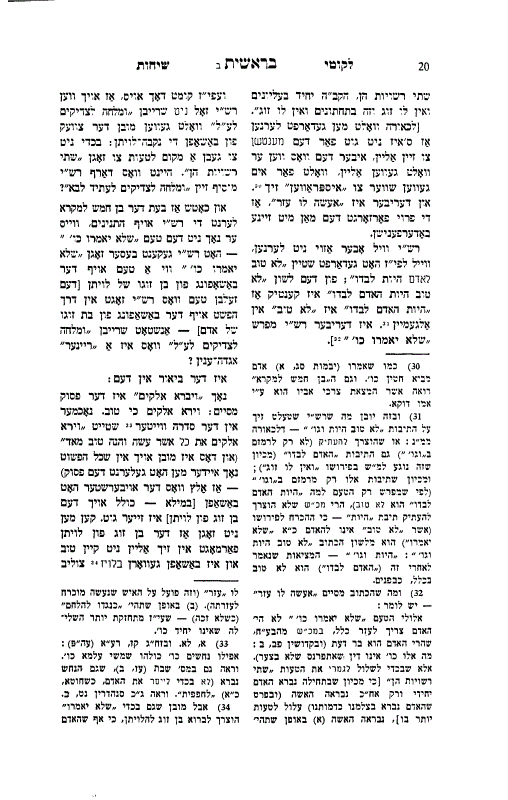
1. On the verse "And G‑d created the great sea creatures (hataninim hagedolim)"[1], Rashi comments on the word "hataninim" — without citing the word "hagedolim," "the great" — and explains: "Large fish in the sea." That is, from the word "taninim" alone we already know that taninim are large fish.
This is not understood: the very fact that the verse adds the description "the great" to "taninim" seemingly shows that among taninim there are different kinds of fish, large and small. Why, then, does Rashi say that taninim are large fish?
2. After the explanation "large fish in the sea"[2], which Rashi gives according to the plain meaning of Scripture, he adds: "And in the words of the Aggadah: this is the Leviathan."
Why does Rashi bring words of Aggadah here, when the purpose of Rashi's commentary on the Torah is the plain meaning[3]? The simple explanation is: the way of plain meaning by itself does not yet state clearly what the word taninim means (we know only that they are large fish, but we do not know what kind of fish they are), so Rashi has to resort to the explanation of the Aggadah[4] — that this is the Leviathan.
However, with the "words of the Aggadah" that Rashi adds, the question from the wording of the verse, "the great taninim," on his explanation "large fish" becomes even stronger:
Had Rashi not brought the "words of the Aggadah," one could have explained (at least with some strain) that by the explanation "large fish" Rashi means only to give a sign by which to identify the fish called taninim — that they are large (but not that the word taninim itself denotes the greatness of this fish).
In that case the question from "the great taninim" would not have been so strong, for we find something similar in other places[5], where the verse adds a description to a certain word only to emphasize the point that the description brings out, since the thing called by that name always has that quality.
But since Rashi's bringing the "words of the Aggadah" makes it clear that by the way of plain meaning we do not know which kind of fish is called taninim, it seemingly proves that by the explanation "large fish" Rashi means [not to give a sign for the taninim-fish, but] to give the meaning of taninim[6] — that the word taninim means large fish[7].
This is difficult[8]: if taninim by itself means large, there is no room to add "the great" after the word "hataninim"!
3. After Rashi brings the Aggadah's explanation that taninim "is the Leviathan," he adds "and its mate"[9] — that taninim refers not only to the male Leviathan but also to its mate. He then also cites the continuation of the Aggadah: "For He created them male and female, and He killed the female and salted it for the righteous in the Time to Come"[10], "for if they would be fruitful and multiply, the world would not be able to stand before them"[11]. And Rashi concludes: "Hataninim is written" — which explains why the word is written hataninim without a yud, in the singular[12]: because after G‑d killed the female Leviathan, only one tanin remained.
This is not understood: to explain which kind of fish is meant by taninim, it is enough to say "this is the Leviathan." Why does Rashi also cite the further words of the Aggadah?
4. On a first reading of this Rashi, it might seem that Rashi is troubled by the following in the word hataninim:
From the way the word is read, "hataninim" (with a yud), in the plural, and also from the phrase "the great taninim," it is clear that the verse speaks of more than one tanin. Why, then, is it written hataninim (without a yud), in the singular?
To answer this question, Rashi brings the words of the Aggadah, that hataninim does indeed mean more than one — two: "it and its mate"; but it is nevertheless written hataninim in the singular because "He killed the female," and only one tanin remained[13].
In truth, however, it cannot be explained this way. For when Rashi explains the reason why a certain word is "written defectively," his way everywhere[14] is to state first that the word is defective, and then to explain the reason for it —
because the questions concerning "defective" and "full" spellings, being connected only with the written form, are not so strong (in the way of plain meaning)[15], and the "five-year-old beginning Scripture" may not notice them. Rashi therefore cannot begin with the explanation; he must first point out the difficulty he wishes to resolve.
Now, since in our verse Rashi writes "hataninim is written" after the explanation "and He killed the female," it is evident[16] that with the words of the Aggadah he means to answer a question that the child asks on his own; Rashi does not need to point the question out to him at all.
Only, since hataninim also presents the difficulty that it is defective, after Rashi has brought the words of the Aggadah and answered the obvious question, he adds "hataninim is written" — that through the words of the Aggadah the question of why hataninim is written without a yud is answered as well.
5. The explanation of this is:
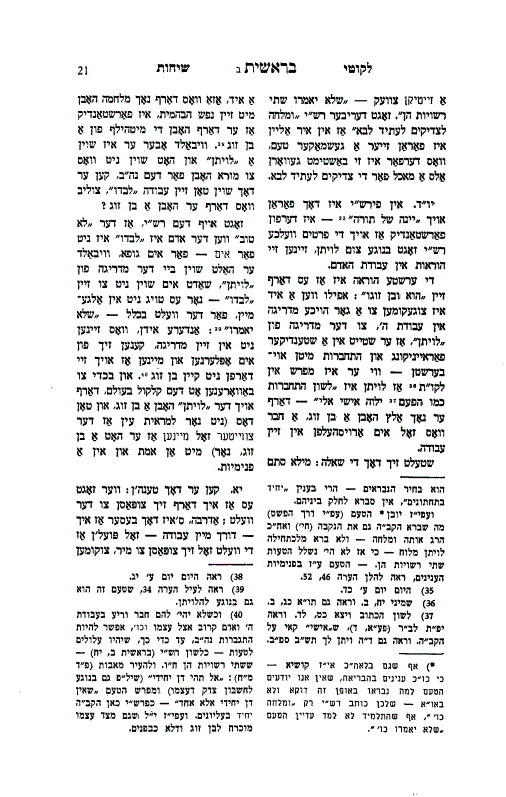
After the words "And G‑d created the great taninim," it says "and every living creature… with which the waters swarmed." This is difficult: "every living creature" also includes the taninim [as is evident from the preceding verse[17], which says only "Let the waters swarm with swarms of living creatures," which includes all kinds, taninim too; taninim are not mentioned there separately]. It would therefore have been enough to say "And G‑d created every living creature…." Why are "the taninim" singled out?
On this Rashi explains: "Hataninim — large fish": the taninim are counted separately because they (the taninim of our verse[18]) are "large fish."
But the five-year-old beginning Scripture argues: among the other fish too there are different kinds, smaller and larger, and nevertheless they are all included in "every living creature." Must the taninim-fish, merely because they are even larger, be counted by themselves?
To this Rashi brings that taninim means the Leviathan[19], which is known (even among children[20]) for its extraordinary size; and since the measure of the Leviathan's greatness is of an entirely different order, not at all comparable to the size of all other kinds of fish, it is counted by itself[21].
This also makes it understandable why "the great taninim" stands before "every living creature" — although the tanin is only one kind — because this one kind, by virtue of its exceptional greatness, is more important than all "every living creature."
6. When Rashi writes "And in the words of the Aggadah: this is the Leviathan," he must immediately add "and its mate." For the Aggadah (Midrash) on this very verse[22] says that the Leviathan has no mate, which is why hataninim is written in the singular.
But this immediately raises a difficulty: from the wording "the great taninim" (read with a yud) it is clear that the verse speaks of more than one tanin. How, then, can one explain according to the plain meaning that hataninim refers to one Leviathan[23]?
Rashi therefore adds "and its mate": he means the Aggadah from another place[24], which says that hataninim are two — "the Leviathan and its mate."
7. All the kinds of creatures that G‑d created must exist now as well[25] (unless there is a special reason — as here, in the conclusion of Rashi's comment). Consequently, when the five-year-old beginning Scripture learns that G‑d created the Leviathan and its mate, he will make a mistake in the plain meaning of the verses, thinking that (the female Leviathan, too, exists now, and that) the verse that follows immediately, "And G‑d blessed them…," also speaks of the Leviathan — as the verse plainly reads.
Rashi therefore forestalls this: "For He created them male and female, and He killed the female"[26] — "And G‑d created the taninim" does indeed mean two taninim, "male and female," but afterward "He killed the female," and so only one Leviathan remained.
8. Once Rashi brings "He killed the female," he must add [not only the reason why "He killed" it[27] — "for if they would be fruitful and multiply, the world would not be able to stand before them" — but also] "and salted it for the righteous in the Time to Come." For otherwise it would be entirely incomprehensible why G‑d created the mate at all, since He killed it[28].
9. Seemingly one could ask:
On the verse "It is not good for man to be alone"[29], Rashi explains: "So that they should not say there are two powers: the Holy One, blessed be He, is alone among the beings above and has no mate, and this one is alone among the beings below and has no mate."
Seemingly one should have explained that it is not good for the man to be alone because, were he alone, it would be hard for him to manage — and therefore "I will make him a helper," that the woman should provide for the man's needs.
Rashi, however, does not want to explain it this way, because according to that it should have said "It is not good for the man to be alone"; from the wording "It is not good — man's being alone," it is evident that "man's being alone" is "not good" in general[30]. Rashi therefore explains, "So that they should not say…"[31].
Accordingly it follows that also regarding the Leviathan, even if Rashi had not written "and salted it for the righteous in the Time to Come," the purpose of creating the female Leviathan would be understood: so as not to give room for the error of saying "there are two powers." Why, then, must Rashi add "and salted it for the righteous in the Time to Come"?
And although when the five-year-old beginning Scripture learns this Rashi on hataninim he does not yet know the reason "so that they should not say…," Rashi could still better have given "so that they should not say…" as the reason for the creation of the Leviathan's mate [the same reason Rashi gives by way of plain meaning for the creation of man's mate] instead of writing "and salted it for the righteous in the Time to Come," which is a "pure" matter of Aggadah?
The explanation of this is:
After "And G‑d created," the verse concludes: "And G‑d saw that it was good." Moreover, further on in the sidrah[33] it says, "And G‑d saw all that He had made, and behold, it was very good" (and this is understood by plain reason even before one has learned the verse) — that everything G‑d created [including, then, the Leviathan's mate] is very good. One cannot say, then, that the Leviathan's mate has no good in itself and was created only[34] for another purpose — "so that they should not say there are two powers." Rashi therefore says "and salted it for the righteous in the Time to Come": in itself it has a very fine taste, which is why it was designated as food for the righteous in the Time to Come.
10. Rashi's commentary also contains "the wine of the Torah"[35]. It is therefore understood that the details Rashi states regarding the Leviathan are also lessons in man's service of G‑d.
The first lesson is that there must be "it and its mate": even when a Jew has reached a very high level in the service of G‑d, the level of "Leviathan" — that he stands in constant union and attachment with G‑d, as explained in Likkutei Torah[36] that Leviathan (livyasan) is "an expression of joining, as in 'This time my husband will be joined (yilaveh) to me'"[37] — he still needs a mate, a companion who will help him in his service.
The question arises: with an ordinary Jew, one who still has to wage war with his animal soul, it is understandable that he needs the help of a mate[38]. But since he is already a "Leviathan" and no longer has anything to fear from the animal soul, he can do his service "alone." Why does he need a mate?
To this Rashi says that the "not good" when the man is "alone" is not for him — for him himself, since he is already at the level of "Leviathan," being "alone" does him no harm — but it is not good in general, for the world as a whole: "so that they should not say"[39]. Other Jews, who are not at his level, may learn from him and think that they too need no mate[40]. To forestall this damage in the world, the "Leviathan" too must have a mate, and do so (not merely for appearances, so that the other should think he has a mate, but) truly and inwardly.
11. He could argue: who says that I must adapt myself to the world? On the contrary, it is better that I, through my service, should bring the world to adapt itself to me — to reach the level of Leviathan; and as for those who cannot do this — "of what account are they?"
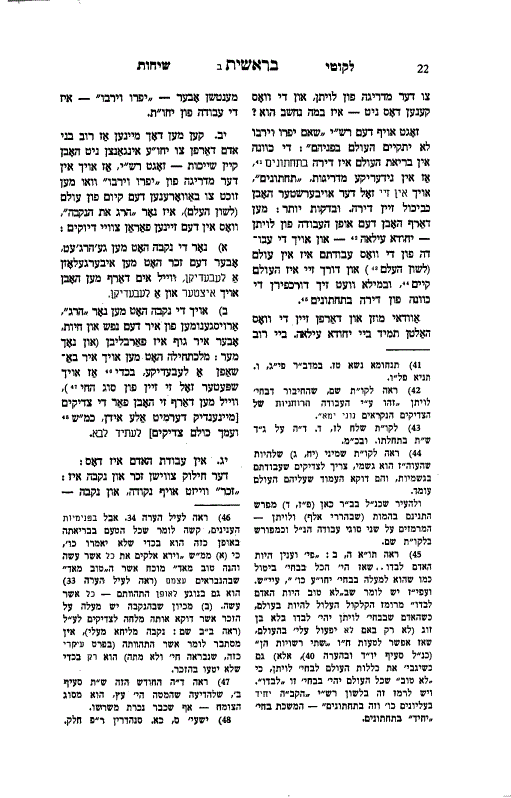
To this Rashi says: "For if they would be fruitful and multiply, the world would not be able to stand before them." The intent in the creation of the world is a dwelling place in the lower realms[41] — that in the low levels, the "lower realms," too, G‑d should have, as it were, His dwelling. More subtly: there must be the mode of service of the Leviathan — the "higher unity" (yichuda ila'ah)[42] — and also the service of those whose service is in the world (olam, an expression of concealment, he'elem[43]), and through whom the world endures[44]; and in this way the intent of a dwelling place in the lower realms will be fulfilled[45].
Certainly there must and should be those who stand constantly at the level of the higher unity. For most people, however — "be fruitful and multiply" — the service is that of the "lower unity" (yichuda tata'ah).
12. One might then think that most people need have no connection at all with the higher unity. Rashi therefore says that even at the level of "be fruitful and multiply," where the concern is to preserve the existence of the world (olam, an expression of concealment), it is only "He killed the female," in which there are two points of precision:
a) Only the female was killed, but the male was left alive, because he is needed now as well, and alive.
b) The female too was only "killed" — its soul and life-force were taken out of it, but its body remained (and more than that: from the outset it too was created alive, so that[46] later as well it should be of the category of living things[47]), because it is needed for the righteous [meaning all Jews, as it is written[48], "And your people are all righteous"] in the Time to Come.
13. In man's service of G‑d this is as follows:
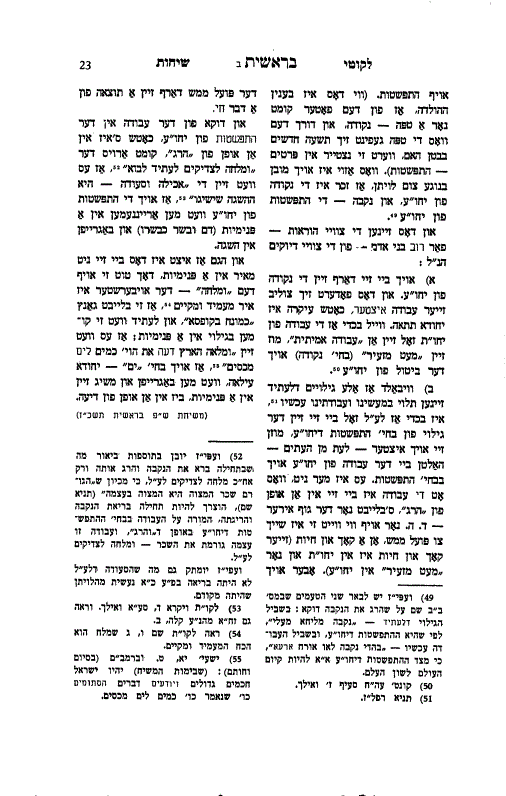
The difference between male and female is that "male" denotes a point, and female — expansion. (As in the matter of procreation: from the father comes only a drop — a point — and through the drop's being nine months in the mother's womb it is developed into details — expansion.) So too it is with regard to the Leviathan: the male is the point of the higher unity, and the female — the expansion of the higher unity[49].
And these are the two lessons — for most people — from the two points of precision above:
a) They too must have the point of the higher unity. This is needed for their present service, even though its main part is the lower unity; for the service of the lower unity to be a "true service," there must also be "a tiny bit" (the level of a point) of the self-nullification (bittul) of the higher unity[50].
b) Since all the revelations of the Time to Come depend on our deeds and service now[51], in order that in the Time to Come they should have the revelation of the expansion of the higher unity, they must also now — from time to time — engage in the service of the higher unity in its expansion as well. Only, with them this service is in the manner of "killing": only the body remains — that is, only insofar as it relates to actual deed, without strength and vitality (their strength and vitality are in the lower unity, and only "a tiny bit" in the higher unity). But the actual deed, too, must be the outcome of something alive.
And precisely from the service in the expansion of the higher unity, although it is in the manner of "killing," comes the "and salted it for the righteous in the Time to Come"[52]: there will be "eating and a feast — this is the comprehension they will attain"[53], that the expansion of the higher unity, too, will be absorbed inwardly ("blood and flesh like his own flesh") and grasped in comprehension.
And although now it does not shine for them inwardly, it nevertheless accomplishes the "and salted it" — G‑d sustains and preserves it[54], so that it remains whole, "as if lying in a box," and in the Time to Come it will come into revelation, inwardly: "The earth will be filled with the knowledge of G‑d as the waters cover the sea"[55] — that even the level of "sea," the higher unity, will be grasped and comprehended inwardly, to the point of knowledge.
(From a talk of Shabbos Parshas Bereishis, 5727)